
A Nuclear Conversation
A conversation the Prime Minister would rather not have

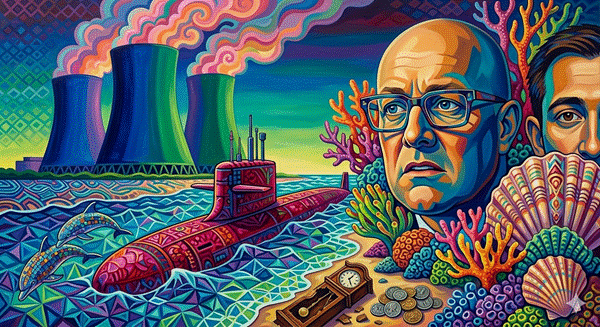
There must be something in the air in the Prime Minister’s suite of the Beehive — a virus of omnipotence and omniscience that seems to infect whoever occupies the office. Jacinda Ardern demonstrated it in spades, with her authoritarian kindness and her government’s self-appointment as the nation’s single source of truth. Christopher Luxon now ventures forth in the same spirit, shutting down any debate on the nuclear question before it can begin.
What he does not appear to understand is that the nuclear issue reaches well beyond the Bomb. Nor does he seem aware of the actual limits of New Zealand’s “anti-nuclear” legislation, which does not prohibit the peaceful use of nuclear energy at all. But the more troubling thing is the arrogance of trying to close a conversation down.
This article challenges that dismissal — a dismissal aimed squarely at the modest proposal of his own Defence Minister, Chris Penk. It may well fail to change the Prime Minister’s mind. But if he reads it, he might at least be better informed.
What Penk actually asked
The conversation the Defence Minister wanted was a narrow and reasonable one. Speaking at the Shangri-La Dialogue in Singapore, Chris Penk suggested it would help to distinguish nuclear propulsion from nuclear weapons when we think about our nuclear-free position.
The occasion was entirely concrete. Under the AUKUS pact, Australia — our only formal ally — will operate nuclear-propelled submarines, and under the present law those boats would be barred from New Zealand waters. That is not an abstract worry; it is friction with the single country to which we are bound by treaty.
Luxon’s response was to slam the door. The nuclear-free position, he said, “ain’t changing” while he is Prime Minister, and he ranked it among the best things the country has ever done.
Penk hastily clarified that he had never proposed changing the policy — only to discuss what regional defence looks like now that Australia is going nuclear-powered.
Labour’s Chris Hipkins, scenting political blood, declared his party would “never change” the nuclear-free status and accused National of quietly entertaining something it had never put to voters. Of course, he too fails to recognise that New Zealand’s law does not prohibit nuclear power – only nuclear weapons and propulsion. Rather more limited than nuclear free. But subtlety and nuance have never been Hipkins’ strong suit.
Within forty-eight hours the entire political class had agreed, loudly, never to discuss the matter.
One word, two very different meanings
The reflex is understandable, because for most of the last fifty years “nuclear” has been a single word carrying two very different meanings, and we have let the more frightening of the two govern our thinking about both.
The mushroom cloud has cast its shadow over the cooling tower. So it is worth saying plainly what this argument is not. It is not a call to build bombs, to loosen restraints on weapons, or to treat proliferation as anything other than the grave danger it is. Weapons are an intrinsic evil, and New Zealand is right to keep its stand against them: the indiscriminate ruin a single device causes can never be justified.
A reactor that turns a propeller, or boils water to spin a turbine, is a different thing entirely. The commentator Liam Hehir put it neatly — nuclear propulsion and nuclear weapons are not morally equivalent, and a question this consequential deserves examination rather than knee-jerk rejection.
We may, after due thought, still decide we do not want allied submarines in our harbours; Australia’s planners will probably manage without a berth in Auckland either way. But we should arrive at that position by reasoning, not by appeals to the glory days of political battles fought four decades ago.
Speaking personally a Virgina class submarine flying the Australian flag steaming (do nuke subs “steam”?) into Auckland harbour would be a sight to behold.
What the law actually says
And here is the fact that so much of the debate contrives to ignore. The New Zealand Nuclear Free Zone, Disarmament, and Arms Control Act 1987 does three principal things: it bans nuclear weapons, it bars nuclear-armed and nuclear-propelled vessels and aircraft from our territorial zone, and it forbids the dumping of radioactive waste at sea.
What it does not do — and never did — is outlaw land-based nuclear power, nuclear research, or the use of radioactive isotopes. None of those things is illegal here; we already rely on nuclear medicine every day. “Nuclear-free,” as written into our statute, has always really meant free of nuclear weapons and nuclear-propelled ships. The blanket meaning that has grown up around the phrase is a creation of sentiment, not of law.
The safety story we got wrong
Begin with the fear, because it is the fear that has driven the policy. Most people’s sense of nuclear risk is anchored to three events — Chernobyl, Three Mile Island and Fukushima — and in each case the popular memory is worse than the record.
No one died from radiation at Three Mile Island. At Fukushima the reactor releases have been linked to a single confirmed radiation death, with the overwhelming majority of that disaster’s toll caused by the earthquake, the tsunami and the chaos of a panicked evacuation.
Chernobyl was a genuine catastrophe — but it was the product of a uniquely flawed Soviet design operated with its safety systems switched off, a machine and a culture no modern regulator would permit.
When you stop reasoning from headlines and start counting bodies per unit of energy, the picture inverts. Oxford’s Our World in Data project, drawing on peer-reviewed modelling, puts nuclear power at roughly 0.03 deaths per terawatt-hour of electricity once Chernobyl and Fukushima are included — comparable to wind and solar, and on the order of hundreds of times safer than coal, which kills around 25 people per terawatt-hour, mostly through everyday air pollution that never makes the news.
Put differently, nuclear causes something like 99.8 per cent fewer deaths than coal and around 97 per cent fewer than natural gas. The source we have feared most turns out to be among the safest we have ever built. The deaths we don’t count — the steady toll of fossil combustion — are the ones that should frighten us.
The demand that changes the math
For years the nuclear debate could be treated as a luxury argument, a matter of preference among abundant options. That era is ending, and the reason is electricity demand of a kind the grid has not seen in a generation. Artificial intelligence and the data centres that run it are the most visible driver.
Analysts project that global data-centre electricity use could reach roughly 945 terawatt-hours a year by 2030 — about the entire annual consumption of Japan — and that United States data-centre demand alone could climb toward 106 gigawatts by 2035, nearly triple its 2025 level. This is not the diffuse, daytime-peaking demand that solar and wind serve so well. It is round-the-clock baseload, and it is being signed for in advance by companies that cannot tolerate intermittency.
The market has already voted. Microsoft contracted to restart a reactor at Three Mile Island — now rebranded the Crane Clean Energy Center — for some 837 megawatts. Amazon secured roughly 960 megawatts for a Pennsylvania campus and signed a 17-year, 1.92-gigawatt agreement with Talen Energy at the Susquehanna plant. Meta struck a 20-year supply deal with Constellation in Illinois and, in early 2026, partnered with Oklo on a 1.2-gigawatt nuclear campus in Ohio; Google is working with Kairos Power on advanced reactors. These are not idealists. They are hard-headed buyers choosing firm, carbon-free power because nothing else does the job as well.
A broad turn, not a fad
It is tempting to dismiss this as a tech-sector fad, but the policy direction is now broad and international. At COP28 in Dubai in December 2023, more than twenty countries launched a declaration to triple global nuclear capacity by 2050 — a list led by the United States, France, the United Kingdom, Japan and Canada — and by the COP30 meeting in 2025 that group had grown to thirty-three, with a rising number of African states among them, on a continent where some 600 million people still lack reliable electricity.
Global nuclear generation reached an all-time high of about 2,667 terawatt-hours in 2024. The major energy-modelling bodies — the IEA, the OECD Nuclear Energy Agency and the IPCC — broadly agree that reaching net zero by mid-century is harder and costlier without a substantial expansion of nuclear, not easier. Treating nuclear as the enemy of climate action gets the physics exactly backwards.
Why this time can be different: small modular reactors
The strongest historical objection to nuclear is not safety but cost: the giant bespoke plants of the past ran years late and billions over budget. The most promising answer is a change of strategy — building reactors small, standardised and in factories rather than enormous and custom-built on site. Small modular reactors (SMRs) aim to turn nuclear construction from a series of one-off megaprojects into something closer to manufacturing, with the cost discipline that repetition brings.
This is no longer theoretical. China’s Linglong One became the world’s first operational commercial land-based SMR, producing around 210 megawatts in Hainan.
In Canada, Ontario Power Generation received construction approval in 2025 for a GE Hitachi BWRX-300 at Darlington, targeting operation by the end of the decade.
The United Kingdom has backed a 470-megawatt Rolls-Royce design with public funding and shortlisted sites. The global SMR market, valued near US$6.9 billion in 2025, is projected to roughly double by 2032. SMRs will not, on their own, meet all the new demand — honest advocates concede as much — but they reopen the door that cost overruns had slammed shut.
The forgotten half: nuclear propulsion
The peaceful case is usually argued on electricity alone, but propulsion deserves its own hearing, because here the safety question is not speculative; it has been answered by sixty years of operation.
The world’s navies have run reactors at sea since the 1950s. The United States Navy alone has accumulated more than 6,000 reactor-years across hundreds of cores without a propulsion reactor ever causing a radiological disaster — a record few industrial technologies of any kind can match.
The civilian record is real too: Russia’s nuclear icebreakers smash through ice several metres thick and operate for months without refuelling, keeping Arctic routes open far longer than fossil-fuelled ships could manage.
That endurance points to the genuinely exciting civilian frontier — decarbonising merchant shipping, among the hardest sectors of all to electrify, because of the sheer energy a cargo vessel needs to cross an ocean.
A reactor’s combination of high power density, near-zero operational emissions and years between refuellings is almost tailor-made for the problem.
Earlier experiments — the Savannah, the Otto Hahn, the Mutsu — foundered on the economics and politics of their day, but compact, passively safe modern designs invite a serious second attempt.
Even if naval propulsion under the SSN-AUKUS programme stays in the defence realm, the underlying technology is the same proven workhorse, and turning it to civilian shipping would attack one of the most stubborn sources of global emissions.
Keeping peace and power apart
None of this requires blurring the line that ought to separate energy from armament — and recognising that line is part of the argument, not an exception to it. Civilian power reactors and naval propulsion plants are governed by a mature international architecture: the Non-Proliferation Treaty, the safeguards and inspections regime of the International Atomic Energy Agency, and the tracking of nuclear material that scales up precisely as capacity grows.
A larger peaceful nuclear sector means more verification, not less. The honest position is to support that regime vigorously — and to insist that fear of the bomb is no longer a good reason to forgo the reactor, any more than fear of arson is a reason to abolish fire.
The metaphor that swallowed the substance
There is an irony worth pausing over. In 2017 Jacinda Ardern reached for the most stirring phrase in our political vocabulary and called climate change “my generation’s nuclear-free moment.”
It was a fine line. But it betrayed no awareness that the very thing she invoked as the emblem of moral courage — the nuclear-free Act — does not, in fact, stand in the way of using nuclear power to cut the emissions she was so determined to cut. The metaphor swallowed the substance. Reflexes do that.
The case against, fairly stated
Intellectual honesty requires naming the strongest objections rather than waving them away, and several are specific to us. Our grid is small and already around 80 per cent renewable, dominated by hydro, which makes the economics of a giant reactor a poor fit and small modular reactors an as-yet-unproven bet.
We sit astride an active fault system, and siting anything nuclear here would rightly face searching questions. The problem of long-lived waste still lacks a permanent geological home in most countries, even if its volume is small and its handling well understood.
Russia’s shelling of Ukraine’s nuclear plants is a sobering reminder that reactors can become targets in war. The fuel supply chains for some advanced reactors — the specialised HALEU they require — are not yet robust, skilled nuclear engineers are in short supply, and permitting can stall projects for years.
Critics reasonably argue, too, that money poured into nuclear might decarbonise faster if spent on cheaper, quicker-to-build renewables and storage. And Hipkins has a genuine democratic point: National did not campaign on any of this, and a change of such symbolic weight should not be slipped through a side door.
These are all serious points. Every one of them is a reason for a careful conversation. Not one of them is a reason to refuse to have it.
Have the conversation
That, in the end, is the whole of the argument. Not that the Prime Minister must change the law, or that we should pour concrete tomorrow — only that he should be willing to think, and to let the country think alongside him.
The safety data have been clear for years. The demand for firm, clean power is now undeniable. The technology has changed, and the propulsion record is decades long.
The weapons question is real and must be guarded against with the full weight of international law — but it is a separate question, and conflating the two has cost us cleaner air, a steadier grid and a faster path away from fossil fuels.
The nuclear-free Act was a true act of conviction in its day, and the stand against weapons remains right. But conviction hardened into reflex is merely another way of declining to look. We would be Luddites to turn our backs on the nuclear option without so much as examining it. Chris Penk asked for a conversation. The adult answer is to have one.
