
A Tudor Trajectory
A Reader's Journey

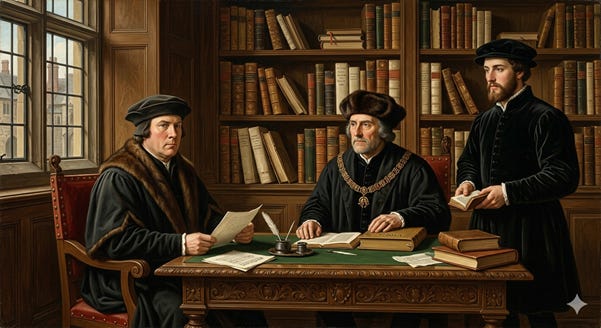
I am an avid and voracious reader. The arcs and trajectories of my reading, as book follows book, are powered by that quality ascribed by Kipling to the Elephant’s Child - a ‘satiable curiosity.
And the trajectory of one reading cycle – a joyful cycle as they always are – began not with a book but with an episode of the second series of Wolf Hall based on Hilary Mantel’s The Mirror and the Light. Mark Rylance gave a very restrained portrayal of Thomas Cromwell – Henry VIII’s chief minister and “fixit man.”
Cromwell has suffered badly over the years. Ruthless and devious, as he was portrayed in the Shardlake series of books by C.J. Sansom, and he was that. But public perceptions of Cromwell may have been shaped – at least until Mantel got to him, by his portrayal in Robert Bolt’s play A Man for All Seasons. The play was about Thomas More and was later made into a movie.
This was required viewing for those of us interested in the law in the mid-1960’s (the film was released in 1966) and it was an interesting representation. The film and play are accurate in theirbroad outlines but paints a significantly idealized portrait that omits some important and troubling aspects of the real Thomas More.
The core narrative is historically solid. The film accurately depicts More refusing to sign a letter asking Pope Clement VII to annul Henry VIII’s marriage to Catherine of Aragon, and refusing to take the Oath of Supremacy declaring Henry the Supreme Head of the Church of England.
At his brief trial in July 1535, perjured evidence was used to convict him of treason, and he was beheaded shortly after. The film also captures real elements of More’s personality — his wit, his devotion to his family, his legal brilliance, and his role as a Renaissance humanist – and it is his humanism that shines through.
Robert Bolt shaped More for dramatic and philosophical purposes. Bolt’s work presents More as “a man of one season” in the sense of belonging to a twilight moment when the Middle Ages were giving way to something new.
Historians have noted that Bolt’s More is written as a vessel for very modern ideas about individual conscience — making the character feel more contemporary than medieval. More’s own sense of conscience was, as one historian put it, “the right to be right, not the right to be wrong,” which is subtly different from the liberal, individualistic More of the film.
What the play and the film omit is More’s role as a persecutor of heretics. The real More was a vigorous and at times ruthless persecutor of Protestants during his time as Lord Chancellor.
More imprisoned a number of men for owning banned books, and historians have argued that the vigour with which he pursued heretics through the courts was relentless — he repeatedly argued that the times demanded strictness because the stakes were so high.
It is for that reason that one scene in the play and the movie - although inspiring and uplifting – is completely out of character with the historical More.
In this scene Richard Riche has just left More’s house. He is seen by More’s family as dangerous, but he has broken no law. Roper, More’s son-in-law, suggests that he would cut down all the laws to get to the devil and More responds with the brilliant summation of the importance of the Rule of Law, saying that he would give the devil benefit of law.
Not so – the devout Catholic More would never give the Devil the benefit of anything – the benefit of the doubt, the benefit of law. Nothing.
There have always been critics for whom More was a fanatical persecutor, alongside admirers for whom he was a “man for all seasons.”
More was personally involved in persecuting some of the heresy cases in England that led to burning — though defenders note the numbers were far smaller than some polemicists have claimed, and that Cromwell’s executions of Catholics after More’s death were proportionally far greater.
The film and play are accurate about the facts of More’s final years and death, and it captures real qualities he possessed. But it presents a sanitized, almost saintly version of the man — understandably so, given it was made partly in the spirit of his 1935 Catholic canonization.
The darker More — the man who burned Protestants for heresy with apparent conviction — is entirely absent from the screen. As one commentator put it, there are essentially “two Thomas Mores” - the saint and humanist friend of Erasmus, and the hammer of heresy. Bolt only gives you only the first.
But for one who was going to pursue the law, some of the idealism about the law that Bolt incorporated and put in More’s mouth were inspiring. The real More may not have given the Devil benefit of the law, but the scene states clearly and succinctly what the Rule of Law is all about. Don’t deny others the benefit of the law, lest you need to rely on it yourself.
The Cromwell\More conflict becomes apparent when More is interrogated by an overbearing Crowell, the record of which is kept by Master Richard Riche. Cromwell is played by Leo McKern (who later went on to immortalize John Mortimer’s Rumpole of the Bailey)
The trial scene is where Cromwell confronts More at trial, arguing that his silence on the matter of the Oath of Supremacy was enough to make him guilty. More cites the Latin legal maxim in reply Qui tacet consentire videtur - “he who is silent is taken to agree” (often shortened as “silence implies consent”) and turns Cromwell’s argument on its head.
More’s problem is that he is undone by the perjured testimony of (now) Sir Richard Riche, played by a very young John Hurt.
Once the writing is on the wall, More unburdens himself and what he says in denying the supremacy of the King over the Church is high treason according to the law and More is condemned accordingly.
But the importance of A Man for All Seasons - at least for me – is what it had to say about the law. What it had to say about Thomas Cromwell is probably obvious and perhaps he is placed in sharp contrast to More to heighten dramatic tension.
But although he is portrayed by McKern as something of a brute, there is no doubt at all that he was an effective Minister for Henry VIII in managing the reforms that the King wanted put in place. Of course, as is the case with all powerful bureaucrats, Cromwell had to take the blame for the consequences of the English Reformation.
Yet he was an efficient administrator, using the power of the printing press to distribute the Royal message. Cromwell used the power of the Royal Proclamation as one means of communication. These proclamations were not only read out in public but were posted where they could be read. And they were printed in such a way – large type and double spaced – that they could be read from a distance. At the time some 60% of the population could read. Not all of them could write and it is for that reason that literacy levels during the Tudor period are considered low.
So after watching the episodes of The Mirror and the Light there was a suggestion around the dinner table that perhaps Cromwell was not the hard-hearted administrator that we see in A Man for All Seasons.
So I turned to Mantel’s excellent book The Mirror and the Light which traces Cromwell’s career through the English Reformation and to the unfortunate matter of the Royal wedding with Anne of Cleves and the way that his opponents engineered his downfall.
And at the same time I traced Cromwell’s career through Diarmaid Macculloch’s excellent biography – Thomas Cromwell.
MacCulloch, upon reading Wolf Hall (the first book in the trilogy) said that “the Thomas Cromwell Mantel was meeting was the Thomas Cromwell he was meeting by looking at the original sources. He praised her ability to capture “the fine grain detail of the Tudor period.”
Cromwell’s rise from the son of a Putney blacksmith to Henry VIII’s chief minister — his legal acumen, fluency in languages, and international experience — aligns well with the historical record. Major events like the fall of Cardinal Wolsey and the execution of Anne Boleyn also align closely with historical accounts.
Mantel conceded that her portrayal of Cromwell was not neutral but angled. Historians note that Mantel telescopes some events and adds to others for dramatic effect, providing Cromwell with motivations and a rich emotional inner life — all of which remains within the fictional realm.
The most pointed criticism concerns the sympathetic tilt. Mantel’s version, while compelling, glosses over some of the more controversial aspects of Cromwell’s career, such as his role in orchestrating show trials and his opportunistic dealings.
Some historians argue that Mantel deliberately reacted against previous studies by portraying Cromwell as the saint and Thomas More as the sinner — a reversal many Catholic and some secular historians find tendentious. Diarmaid MacCulloch himself has noted that More was a much more complex and sophisticated figure than the dessicated fanatic Mantel portrays.
Historians find it difficult to think about Cromwell without Mantel’s interpretation coming to mind — her Cromwell is so real and compellingly lifelike — but it is ultimately a version of what might have been, not a factual record. Mantel’s own argument was that lived experience lies in the “gaps, the erasures and silences” of the documented past — speeches unrecorded, thoughts unspoken.
Thus Mantel’s representation of the character of Cromwell as humane, sympathetic, emotionally intelligent is a creative construction. It’s historical fiction at its most rigorous, but it is still fiction.
So given the rigour of Macculloch’s biography of Thomas Cromwell – which I might add is an excellent piece of writing – what were his conclusions.
MacCulloch’s sympathy for his subject does not detract from his honest portrayal of a complicated man — a genius who often became an embattled focal point in the wars over the direction the English Church would take.
After a decade of sleuthing in the royal archives, MacCulloch found Cromwell the man — an administrative genius — rescuing him from myth and slander. The real Cromwell, in his telling, was a deeply loving father who took his biggest risks to secure the future of his son Gregory, and also a man of faith and a quiet revolutionary.
That said, readers consistently note that MacCulloch’s Cromwell is colder than Mantel’s. MacCulloch portrays Cromwell in far more detail, although less intimately and somewhat more ambiguously than in Wolf Hall, as would be expected from a biography compared with a novel — and for many readers, MacCulloch’s Cromwell is a far less sympathetic character, although equally heroic.
Cromwell was no saint, and the book is no hagiography — but he does emerge as a more sympathetic person than many of his contemporaries. MacCulloch’s central argument is that Cromwell has been badly served by history and by centuries of accumulated propaganda. He made his mark on England, setting her on the path to religious awakening and indelibly transforming the system of government of the English-speaking world.
It’s worth noting that MacCulloch and Mantel actually read each other’s work and corresponded admiringly — but their Cromwells differ in tone. Mantel gives him an intimate interior life and emotional warmth; MacCulloch, working from documents, produces someone more inscrutable and harder-edged.
The biography also gives Cromwell considerably more agency and intellectual ambition than previous accounts, particularly around the English Reformation — framing him less as Henry’s instrument and more as a genuine theological and political visionary in his own right.
MacCulloch’s portrait is genuinely sympathetic but not sentimental. Cromwell comes across as brilliant, driven, and more human than his reputation suggests — but also calculating and capable of ruthlessness. It’s a rehabilitation rather than a whitewash.
So much for the man – what of his administration and the way he instituted the English Reformation. An answer is provided in Tudor historian G. R. Elton’s book Policy and Police: The Enforcement of the Reformation in the Age of Thomas Cromwell. I had cause to consult this book in the course of my doctoral studies especially in examining the use of the printing press and proclamations as a means of communicating the message.
Policy and Police, first published in 1972, has since acquired classic status in the literature on the government of sixteenth-century England. It examines what actually happened during Henry VIII’s break with Rome, the widespread resistance this provoked which necessitated constant vigilance on the part of the government, and the role of Thomas Cromwell, whose surviving correspondence permits a detailed insight both into the purposes of government and the manner in which it was experienced by ordinary people.
Its chapters move through the full machinery of enforcement: rumour, magic and prophecy as threats to order; propaganda as a tool of government; the expanded law of treason; treason trials; and the policing apparatus Cromwell constructed.
The book’s central argument is that enforcing the Reformation was far from straightforward. Resistance was widespread — in taverns, pulpits, and alehouses across England — and Cromwell had to improvise a sophisticated system to manage it. Elton shows him working on several levels simultaneously:
He used propaganda actively, commissioning pamphlets, sermons, and printed material to shape public opinion in favour of the Royal Supremacy. He also relied heavily on informers and denunciations, with letters flowing into his office from across the country reporting seditious words, rumours, and disloyal priests.
Cromwell’s surviving correspondence permits an unusually granular view of how government policy was experienced at the local level — and Elton uses this to show just how hands-on Cromwell was, personally reading and responding to an enormous volume of reports.
On the coercive side, Elton examines the expanded Treason Act of 1534, which made it a capital offence to deny the Royal Supremacy even in words alone — a dramatic extension of the state’s reach.
Yet Elton also found that Cromwell was often more measured in applying this power than his reputation suggests, thus giving some measure of support to the suggestion that Cromwell was not as hard-headed as some would like to portray him.
Elton makes the argument that the Reformation in England did have its outspoken critics and was not necessarily a done deal by 1536 — meaning Cromwell’s enforcement task was genuinely precarious, not simply a mopping-up exercise.
Elton gives us a portrait of a man who was an exceptionally able administrator running what amounted to an early modern intelligence operation — monitoring dissent, managing communications, deploying law as a political instrument, and doing so with remarkable attention to detail.
Elton was an admirer of Cromwell as a governmental innovator, and the book reflects that, presenting him as the architect of a more modern, bureaucratic style of English government, even while documenting the coercive and at times brutal machinery he built to protect the Henrician revolution.
But as I looked though the shelves I came across a book nestled in among the others on the Tudor period about Sir Thomas Wyatt who lived a dangerous life, although one might wonder how this could be for the man who allegedly introduced the sonnet to English literature.
In Graven with Diamonds, Nicola Shulman interweaves the bloody events of Henry VIII’s reign with the story of English love poetry and the life of its first master, Henry VIII’s most glamorous and enigmatic subject.
The book is unusual in its approach — rather than treating poetry as a literary subject separate from politics, Shulman argues that at the Tudor court the two were inseparable. Poetry made things happen. It affected Henry’s wars, his diplomacy and his many marriages. It was at the root of his fatal attraction to Anne Boleyn — the source of her power, and the means of her destruction.
Shulman’s central insight is that the Henrician court was a place where poems were actual physical objects, passed around just as lovers would give each other tokens. The people who received the physical object of the poem would know the keys to unlocking the texts; that is why to later generations the poems seem flat. The book is therefore an act of restoration — reconnecting the poems to the dangerous, intimate world that gave them meaning.
Wyatt (1503–1542) emerges from the book as an extraordinarily multi-faceted figure and favourite both of Henry VIII and Thomas Cromwell. The brilliant Wyatt was admired and envied in equal measure.
He was a distinguished courtier, probable lover of Anne Boleyn (the evidence is anything but conclusive), and the first English poet to write a sonnet.
In Shulman’s assessment, the state of English verse was in sad decline in the early Tudor era, and an educated and witty poet such as Wyatt easily became a master of the poetry of courtly love — filling the gap between Chaucer and Shakespeare with something genuinely new.
His poetry was not art in the modern sense. Courtly love poetry wasn’t intended as literature — none of Wyatt’s verse was published in his lifetime — so much as a means by which courtiers and royalty communicated, gossiped, and upheld standards of chivalry. Henry VIII himself was a practitioner, and Shulman demonstrates that Henry valued Wyatt highly for his poetic ability.
Shulman shows that Wyatt’s life was one of remarkable survival in an age when almost everyone around him perished. Wyatt was involved more than peripherally in most of the major events of the 1530s and 1540s — Henry’s war against France, the breakdown of his marriage to Katharine of Aragon, the English Reformation, the rise and fall of Anne Boleyn and Thomas Cromwell, and the factional struggles among the nobility associated with Henry’s subsequent marriages.
Wyatt’s relationship with Anne Boleyn is one of the book’s most compelling threads. Shulman suggests rather than asserts, conjectures rather than concludes, about the nature of Wyatt’s connection with Boleyn — a suitably cautious approach given the dangers of the subject. Wyatt was one of the men confined to the Tower at the time of Anne Boleyn’s fall, and the only one of that group to make it out alive.
Shulman shows that Wyatt’s lyrics refer, often cryptically, to his love for Anne Boleyn, his two periods of imprisonment where he came close to execution, his association with Cromwell, and his diplomatic manoeuvres in Europe as Henry wriggled in and out of alliances.
After surviving the Boleyn crisis, Wyatt regained favour as a diplomat but was thrown into the Tower again in the wake of the fall of Thomas Cromwell. And yet he survived that too — Wyatt went on to achieve that rarity for a courtier in Tudor England: a natural death.
The book’s most original claim is about how Wyatt used poetry not just to court or entertain, but to endure. When the axe began to fall and Henry VIII’s laws made his subjects fall silent in terror, Wyatt’s poetic skills became a way to survive. He saw that a love poem was a place where secrets could hide.
Graven with Diamonds restores Thomas Wyatt to his proper place: not a minor footnote between Chaucer and Shakespeare, but a man who lived dangerously at the centre of Tudor power, and who used language — beautiful, ambiguous, deniable language — as his principal tool for navigating it.
As I read these books there kept coming to mind another about a courier employed by Cromwell as a go-between with Henry VIII’s relation and erstwhile friend Reginald Pole.
I was sure the book was on the shelves but it was not, yet I had a clear picture both of the title and the cover, as well as the fact that it was written by a New Zealander.
And so I had to use the services of Amazon. The book arrived and it is at this point that the trajectory of this story reaches its end point.
The book is entitled The Courier’s Tale (2010) by Peter Walker. It tells the story through first person narration and what is described as a “documentary novel” of Michael Throckmorton.
I did a little background on Throckmorton. In 2009 Anne Overell published an article in History entitled “Cardinal Pole’s Special Agent: Michael Throckmorton, c.1503–1558”
The article echoes the book.
Told from the perspective of Michael Throckmorton, it’s a picaresque chronicle of his life in Italy and his work as a courier for Reginald Pole — who, after telling off Henry VIII (his cousin), the Pope, the Emperor, and the King of France, ends up as the close counsel of Bloody Mary in her last days.
The novel spans decades, moving from the crisis of the King’s divorce all the way through to the end of Mary I’s reign, making it one of the broadest-canvassed Tudor novels in recent memory.
Throckmorton faced significant dangers, including arrest, assassination threats, and suspicion of treason. He was accused of being a double agent, working for Cromwell and Pole simultaneously. His activities were crucial during key moments like Pole’s legation in 1553 and the attempt to restore papal authority in England.
Reginald Pole (1500–1558) is one of the most dramatic and tragic figures of the Tudor age — a man whose royal blood, religious convictions, and defiance of Henry VIII shaped and scarred his entire life.
His father, Sir Richard Pole, was a cousin of King Henry VII, and his mother, Margaret, Countess of Salisbury, was a niece of Edward IV (a daughter of George, Duke of Clarence)
This made him simultaneously a Tudor kinsman and a Plantagenet — a member of the old royal house that had been swept away by the Tudors after the Wars of the Roses. Although the Tudors were firmly in power by the time Pole was born, his lineage placed him dangerously close to the throne and made him and his brothers an object of suspicion as well as prestige at court.
In recognition of Pole’s royal descent, his cousin Henry VIII paid for Pole’s education at Oxford University and at Padua, Italy, and gave him minor offices in the church. For a time he was a valued and brilliant young man in Henry’s orbit. On Wolsey’s death he seems to have declined the archbishopric of York, and was increasingly opposed to the king’s divorce policy, going abroad again in 1532.
The break came when Henry sought opinions on his divorce from Katherine of Aragon. Asked for his opinion by the king, Pole produced in 1536 a strong counter-statement, placing his relatives in England in acute danger. He then went further — he wrote tracts against Henry and engaged in treasonous activity including plotting to have Henry overthrown, all from the safety of Rome.
Henry’s revenge fell on Pole’s family. His nomination as cardinal increased their peril: his eldest brother was executed, his nephew died in the Tower. Most notoriously, his mother was executed when she was in her seventies — one of the most shameful of Henry’s executions. The executioner was a teenage boy and more than one blow was required to dispatch the matriarch.
Reginald remained in Rome, continuing to write and scheme even as his family were imprisoned and killed.
Pole lived through Henry’s reign, the Protestant reign of Edward VI, and finally came into his own when the Catholic Mary I took the throne in 1553. The pope at once appointed Pole legate for England.
He landed at Dover on 20 November 1554, and ten days later formally received the country back into the Catholic fold. He then began to refound the monasteries, and in November 1555 assembled at Westminster a synod that instituted a number of church reforms.
Soon Pole was virtually running the government. Although he was not directly responsible for the burnings of Protestants that marked Mary’s reign, he did not oppose them. Pole was made Archbishop of Canterbury in March 1556.
His end was almost poetically symmetrical with the reign he had served. He died on 17 November 1558 at Lambeth Palace, a few hours after the death of Mary Tudor. He was the last Catholic Archbishop of Canterbury.
So it is against this background that Michael Throckmorton tells his story and from the start the book is wonderful – a joy to read and elegantly written. The “documentary” aspect of the novel refers to that fact that the author fleshes out the story with quotes from a number of documents.
Walker said in the afterword that this book reads almost like a documentary — all the letters and books described are real, all of the people (except some incidental individuals) really did exist and really did do the things described; he notes that of course the conversations his characters hold cannot be known to be true to life, but even those are based on written documents by the characters themselves.
This methodological honesty is commendable and gives the novel unusual intellectual integrity. The result is a story grounded in primary sources, lending weight to even the most dramatic scenes.
With all that documentary evidence, the story he tells is very lively — indeed, quite thrilling at times — and the style is quite conversational and easy to parse.
Readers who appreciate well-sourced historical fiction will find this approach enormously satisfying. Those seeking purely propulsive narrative fiction, however, may find the documentary passages slow the pace at times. I found that the real voices of the time added to and enhanced the elegance of the story-telling.
Additionally the story makes it clear that while the English Reformation was proceeding apace, in Italy the High Renaissance was happening. Characters like Michelangelo and Vittoria Colonna make numerous appearances. Indeed the first scene in the book takes place in the half completed Capelle Medici in Florence where Michelangelo is working on the tombs of Lorenzon and Guiliano Medici. This opening image perfectly encapsulates the novel’s sensibility: Renaissance grandeur meeting political peril, beauty entangled with danger.
I had to pause when I came to this section for it tells of one of my own favourite places – one of Florence’s secrets. If you want to see Michelangelo’s sculpture by all means spend some time at the Academia and the David.
But the real Michelangelo collection is at the Capelle Medici at the Basilica of San Lorenzo and the crowds at the Academia are not there. A wonderful place for contemplative consideration of Michelangelo’s genius.
Michael Throckmorton is an engaging if somewhat passive protagonist. Throckmorton’s yearning for his native land, and for Judith, the love of his life, is at the centre of the story. His emotional anchorage in personal longing — for home, for love — grounds what might otherwise become a purely political chronicle.
Reginald Pole himself is the more compelling figure. Walker makes a persuasive case for why this largely forgotten Englishman deserves greater attention: a man who navigated the competing demands of faith, family loyalty, royal blood, and intellectual integrity across one of history’s most dangerous courts.
Walker’s prose is accessible and unshowy — a refreshing contrast to some of the more mannered Tudor fiction on the market. It’s funny and lyrical as well, and as I have noted Walker used primary resources where he could; the dialogue he brings to that narrative is believable and well done.
The shortness of the chapters was very appreciated, as was the balance between descriptions of place and reflections on theology, art, philosophy, and politics. It was a book about conversations and letters more than more physical things. Readers who like their historical fiction cerebral and ideas-driven will find this a rewarding quality.
The novel was widely marketed with the tagline “If you loved Wolf Hall, you will delight in The Courier’s Tale,” a comparison that is both apt and somewhat double-edged.
Both novels occupy the same Tudor landscape and both take non-obvious protagonists as their entry point. The Courier’s Tale is a formidable debut novel which deserves as much, if not more, success than Wolf Hall. Some enthusiastic readers even prefer Walker’s more grounded, less stylised approach to Mantel’s celebrated present-tense experiments.
The Courier’s Tale is a serious, intelligent, and often pleasurable piece of historical fiction. Its greatest strengths are its scholarship, its rehabilitation of the fascinating and neglected figure of Reginald Pole, and its wide-angle view of the Reformation from both sides of the Channel.
For readers with a genuine appetite for the religious and political history of sixteenth-century Europe, it is a richly rewarding read.
A beautiful tale, elegantly told.

Thanks Halfling.
I'll be following up all the links to the books you mention.
I've been impressed, while studying the second half of the sixteenth century, through the truly fascinating lens of advocates of Edward de Vere, by a few things:
Education for the elite was of at least one order above what's available in our best private schools now.
From all the surviving letters, etc., I know exponentially more about de Vere and others, than about my grandfather, who died five years before my birth
Elizabeth held the printers in an iron grip: All paper had to be accounted for. All publications had to be vetted.
I was surprised by your figure of 60% literacy, at least for reading, if not writing. My feeling is that only the wealthy, and maybe half the bourgeoisie, mostly men, by and large, could read. Peasants got things read out to them.
I thought this didn't change much until the early 20th century.
Man oh man, those people were good to us! They cooked the English language into a powerful, flexible unit.
See you! I'm off to write some poetry.