
Multiplying Inaccuracy
How "Multiple" Covers Up Sloppy Journalism

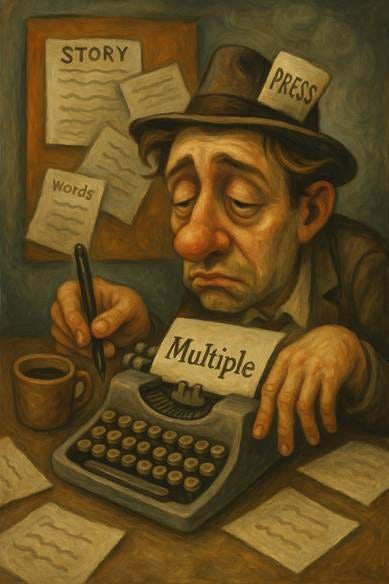
The word “multiple” is both a noun and an adjective.
As a noun the word has a specific meaning in mathematics. It is defined in the Oxford English Dictionary as a quantity which contains another quantity some number of times without remainder. Thus, 4 is a multiple of 2; 6, of 2 and of 3. Any multiple of five will end with either a zero or a five. The lowest common multiple of 4 is 8 and 12.
As an adjective it generally means many – the OED definition is
“Consisting of or characterized by many parts, elements, or individual components; having many origins, results, influences, issues, or the like; manifold. With pl. n.: Many and various.”
The OED gives examples which it described as special collocations –
multiple birth - the birth of more than one child at a single confinement;
multiple exposure in photography - the repeated exposure of the same frame of a film so as to produce superimposed images;
multiple image - a composite image comprising two or more superimposed or adjacent images originally distinct (e.g. resulting from the repeated reflection of light, the reception of television signals that have travelled from the transmitter by different paths, or the simultaneous showing of several scenes on a cinema screen);
multiple personality - a dissociative condition in which an individual's personality is apparently split into two or more sub-personalities, each of which may become dominant and then is relatively distinct and complete;
multiple pregnancy - a pregnancy which would normally result in a multiple birth;
multiple resistance - resistance of a micro-organism to the action of more than one antibiotic; so multiple-resistant
are just a few examples.
But the word “multiple” is being used frequently in journalism. It is a practice that I have noticed has been taking place for some time. I thought little of it but as the use of the word seems to be on the increase and because it is being used in a number of contexts, it has caused me to reflect why it is that the word is used so frequently and apparently with such gay abandon.
The matter moved into sharp focus as the result of a couple of article about James Gardner-Hopkins – a lawyer suspended from practice who is seeking to renew his practicing certificate.
I want to make it clear that I hold no brief neither for nor against Mr. Gardner-Hopkins. He has been through a disciplinary process and the matter is in the hands of the Law Society who will determine the issue of his right to practice law.
My concern is with the reporting of a recent issue associated with his attempt to resume practice. The matter was reported in the NZ Herald for 9 August 2025 opening with the following paragraph:
“Multiple female lawyers claim that a former senior partner who was suspended for drunkenly groping interns at a Christmas party has been using a social media platform to intimidate them.”
Four paragraphs down the following appears:
“Multiple branches of women’s law associations, and their individual members, opposed his readmission to the profession and made submissions to the New Zealand Law Society
However, following those submissions, multiple women have complained that Gardner-Hopkins has found their profiles on the social media networking site LinkedIn, and has been repeatedly accessing them to “intimidate” them.”
The Wellington Women’s Law Association is quoted as saying:
“There is an option to view LinkedIn profiles anonymously, yet he has chosen not to use it. Over the past few days, this behaviour appears to have escalated, with some women reporting it has occurred multiple times. There appears to be no legitimate reason for him to be doing this.”
Thus in the one article there has been the use of the word “multiple” on four occasions. More on this later.
A similar story about Mr Gardner-Hopkin’s actions was reported by Radio NZ for 9 August 2025. It is basically a repeat of the article in the NZ Herald and is by Jeremy Wilkinson who wrote the Herald piece and he is described as the Open Justice report for the Herald.
But this practice, as I suggested, is not restricted to an isolated incident. In a story about AT incorrectly issuing fines to a mobility parking permit holder in the NZ Herald for 2 August 2025, Tara Shaskey – another “Open Justice” journalist - uses the word twice.
“Clark said registering vehicles could also pose a problem for older permit holders who might not remember to update which vehicle they are travelling in, if they have multiple registered vehicles.”
“The issue was that the permit was for a person, not a vehicle, and the person could ride in multiple vehicles, he said.”
I have to confess that I have not kept track of the use of the word over the last few weeks, but I did a search of the Herald website and came across some examples which I shall share.
Saul Maniapoto-Bernsten deemed insane at time of shooting uncle multiple times – NZ Herald 11 August 2025
Man charged with assault after Hutt Valley baby found to have multiple broken bones – NZ Herald 6 August 2025
From that second article come the following:
A man has been arrested and charged after a 3-month-old baby girl was taken to hospital in the Hutt Valley with multiple broken bones - but no charges have been laid over her more serious injuries.
“These injuries were unusual for a child so young, and an examination at the hospital identified multiple fractures,” he said.
And again:
Whanganui District Council grapples with vandalism across multiple public sites - NZ Herald 5 August 2025
From that article comes the following:
Vandalism across multiple council sites in Whanganui has been branded as “cowardly”, with cameras going up to stop antisocial behaviour.
About the tsunami warning:
Tsunami alert glitch: Civil Defence investigates multiple early alarms – NZ Herald 31 July 2025
From that article comes the following:
Civil Defence is investigating after a “glitch” led to some people receiving multiple tsunami advisory emergency alerts in the early hours of this morning, National Emergency Management Agency [Nema] director John Price says.
But multiple people told the Herald or complained on social media of being woken by alerts between 1.50am and 3am.
A caption to an illustration in that article reads
This image shows the epicentre of an 8.8 earthquake that hit off Russia's far east yesterday, sparking tsunami warnings across multiple countries. Photo / US Geological Survey
These examples are by no means exhaustive. But neither are they random and they are certainly not coincidental. It appears to me that the word “multiple” seems to be the word of first resort for journalists who want to record either that there has been more than one incident as described or that a large number of complaints, incidents and the like gives some validity to the issue.
In many cases it seems to me that numbers imply validity. This suggestion is reminiscent of the concept of “the wisdom of the crowd. This concept refers to the idea that the collective judgment or opinion of a large, diverse group of people can be surprisingly accurate—sometimes even more accurate than that of individual experts.
It rests on some key assumptions which are often characterised as (or elevated to) principles. First there is diversity of opinion which holds that each person brings different perspectives, information, and biases to an issue. Then there is independence which suggests that people form their views without being unduly influenced by others. The idea of decentralisation suggests that no single person or authority controls the decision-making and finally aggregation provides a way by which individual judgments are combined into a single collective decision.
The suggestion is that when these conditions are met, the group’s combined answer often averages out errors and extremes, converging toward a result close to the truth. The downside to the theory is that the wisdom of the crowd can fail—especially if the group lacks diversity, is swayed by groupthink, or if its members are poorly informed.
But the use of the word “multiple” by journalists would seem to suggest that a problem is widespread or, in the case of an opinion, that a number of people holding the same point of view have got it right.
In the article about Gardner-Hopkins the word is used in two contexts. One is to provide an indication of the number of people who have concerns about Mr Gardner-Hopkins activities on LinkedIn. The other is to provide an indication that he has accessed certain profiles more than once.
In both cases the use of the word is both pejorative and lazy.
It is pejorative because it gives rise to the suggestion of a widespread problem without providing any specific evidence of just how widespread it might be. But perhaps precise numbers may dilute the seriousness of the problem. Or perhaps they may enhance it. Either way, the provision of a precise number would crystallise the scope of the problem and provide the reader with more accurate information than is implied by the use of the word “multiple.”
The use of the word by the journalists is lazy. Either they have been working off a press release (which is often the case these days) or they have not bothered to carry out the investigative work necessary to identify with precision the numbers that lie behind the word “multiple’. I hesitate to suggest that many of them cannot count beyond 5 and use a catchall word like “multiple” to suggest “ a lot”.
When you look at each of the examples I have given when the word “multiple” is employed the question “how much” or “how many” begs to be asked. How many vehicles, how many broken bones, how many public or council sites, how many early alarms, how many people, how many countries. These are all valid questions which if properly asked and answered by a competent and diligent journalist would more accurately inform the reader of the scope of the problem.
If journalists were prepared to do their job and were prepared to be accurate in their enumeration of the scope and size of a problem, there may be increased confidence in reporting. As it is, the use of catchall words which lack specificity and cloud precision do nothing to improve the rather dire state of journalism currently exhibited by mainstream media.
One of the few correct uses in your examples is 'multiple fractures', a medical term. But 'multiple people' - ouch. With only a handful of sub-editors left at NZME, it's hardly surprising things like this are slipping through. AI can do quite a bit of what sub-editors used to, but not everything.
So very true. I am informed by multiple sources that modern MSM journalists have indeed been found wanting. Appeals to implied legitimacy are popular among those who lack a decent argument. Our fatty former failed finance fraudster (who is afraid to front up) loved to use lines like ‘I’m sure you know all New Zealanders accept xyz…’