
Nolan's Odyssey
A Review of the Cinematic Retelling of Homer

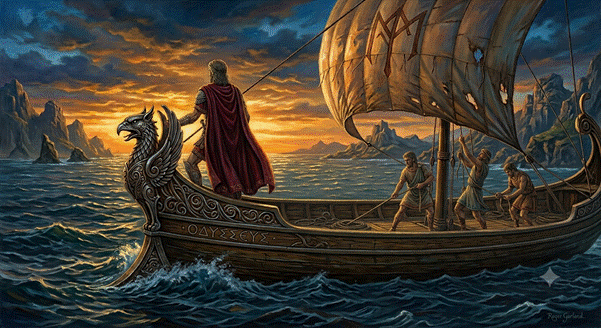
Christopher Nolan has undertaken a mighty task: to turn Homer’s Odyssey, an epic poem of 12,109 lines, into a film that captures the magic of the original, tells the story as faithfully as a visual adaptation can, and articulates the themes woven through the epic. Those themes interlock, and they are realised through the poem’s very structure, so what follows is necessarily a summary. But it is worth considering the major ones, and how Nolan handles each.
The theme that receives perhaps the most attention is xenia, or hospitality. The sacred guest-host relationship, protected by Zeus, functions as the poem’s moral measuring stick: characters are judged by how they treat strangers.
The Phaeacians feast Odysseus and ferry him home (good xenia); the Cyclops eats his guests (a monstrous perversion of it); Circe and Calypso detain their guests too long; and the suitors commit the ultimate violation by devouring another man’s household uninvited. Their slaughter in Book 22 reads as divine justice for this transgression — Odysseus’s first arrow strikes Antinous as he lifts a wine cup, the very emblem of abused hospitality.
Nolan preserves this gauntlet of temptations and hospitality-violations as spectacle with teeth: a staggering, grotesque Cyclops; haunting, sorrowful Sirens; the giant Laestrygonians; Circe turning the crew to pigs, done with practical effects; and Calypso holding Odysseus captive.
The Cyclops sequence is staged for dread rather than adventure — the men huddle in the dark with only stray glimpses of the monster’s hands.
There is also a distinctly Homeric shift: the crew ignore ominous warnings from villagers they have pillaged before being beset by storms and monsters, so that their suffering is more clearly self-inflicted — an echo of Zeus’s opening complaint in the poem that mortals earn their own doom.
Nolan’s boldest twist on xenia, however, concerns the biggest gift of all: the horse ostensibly left by the Greeks upon abandoning the siege of Troy. The gift is Odysseus’s idea, a means of breaching the city’s impregnable gates, and it is the ultimate perversion of guest-friendship, weaponising a sacred parting gift into an instrument of slaughter.
In ancient Greek culture a gift given to gods or hosts carried divine protection, which made the deception a profound religious crime. A parting gift is meant to bless the receiver and seal peace between departing parties; the belly of this one contained the very soldiers who would burn Troy to the ground. The Trojans took it into the heart of their city — their most sacred space — and so invited their own destruction past walls no army could breach.
In Nolan’s telling the horse haunts Odysseus throughout, and the Fall of Troy that flowed from his cunning comes to symbolise the end of a golden age and the chaos that follows. The poem sets many other forces against Odysseus — not least the gods, whom he manages to offend and for whose wishes he seems to care little — but it is this perversion of the peace-gift that rings down through Nolan’s film.
Another theme — some would say the most obvious — is nostos, the homecoming. The entire poem is organised around the hero’s return.
Odysseus’s ten-year journey home to Ithaca gives the epic its shape, but Homer deepens the theme by multiplying it: Books 1–4, the “Telemachy”, follow Telemachus seeking news of his father, while Nestor and Menelaus recount their own returns from Troy. Agamemnon’s disastrous homecoming — murdered by his wife’s lover — hangs over the poem as a dark counter-example, repeatedly invoked to show what Odysseus’s return could become.
Crucially, homecoming means more than physical arrival. Odysseus lands on Ithaca halfway through the poem (and in the last quarter, if that, of the film), and the entire second half is devoted to reclaiming his identity, his household and his marriage.
For Nolan, that marriage was never in doubt. Despite Odysseus’s years of lotus-eating on Calypso’s isle, Penelope remains steadfast — no Clytemnestra she, though in fairness Agamemnon’s sacrificial murder of his daughter Iphigenia is generally seen as Clytemnestra’s prime motivation, with the presence of the captive Trojan princess Cassandra an aggravating factor.
Nolan keeps homecoming as the spine of the story but filters it through his career-long obsessions: the immutability of time, and the danger of being trapped too long inside a memory. This Odysseus has more than a little of Inception‘s Cobb about him.
The key invention is that Odysseus begins the film having lost his way and his memories after years on Calypso’s island, urged onward by visions of Athena as he slowly recalls the journey from Troy. The physical journey home thus becomes inseparable from a psychological journey back into memory: Homer’s nostos becomes a return to self before it can be a return to Ithaca — which is, in fact, a very faithful reading of the poem’s insistence that arrival alone is not homecoming.
The Telemachy survives largely intact. Telemachus, weary of the suitors pursuing his mother, travels to Sparta to learn whether his father lives, unaware of the plot against his life led by Antinous.
The dual-narrative structure does real thematic work: the Telemachus strand gives us Odysseus the man and father, while Odysseus’s own memories present the warrior and leader — an identity split between how others remember him and how he sees himself.
Then there is Odysseus’s metis, his cunning intelligence. The word polytropos appears in the poem’s first line, rendered by Emily Wilson as “complicated”, by Daniel Mendelsohn as a man of “roundabout ways”, by Peter Green as “resourceful” and by Robert Fagles as the man “of twists and turns”.
Odysseus is defined by metis rather than the brute strength of an Achilles, and the poem realises this in episode after episode: he escapes the Cyclops not by fighting but by the “Nobody” trick (absent from Nolan’s telling) and by hiding beneath the rams; he survives the Sirens by having himself bound to the mast; he returns home disguised as a beggar rather than storming his own palace.
Homer’s celebration of trickery gets a darker recasting from Nolan, and it is tied directly to xenia. The Trojan Horse — in the poem a proud emblem of metis — becomes the source of Odysseus’s torment. He is praised for winning the war, his most regrettable achievement immortalised in ballad, while guilt drives ten years of wandering, lost in his own pain; it is resilience, and the desire to make things right, that finally lets him return.
Matt Damon’s Odysseus is accordingly more haunted than wily. Where Homer’s hero suffers because of the gods and bad luck, Nolan’s suffers largely because of what his cleverness accomplished at Troy: cunning carries a moral bill. Reviewers have seen this as continuous with Oppenheimer — another interrogation of masculine ego and hubris, though delivered here with an emotion-driven soulfulness.
Penelope mirrors him. Her weaving and unweaving of Laertes’ shroud is cunning turned to feminine ends, and her final test of Odysseus — the secret of their bed, another element absent from Nolan’s telling — shows her to be his intellectual equal.
Her cunning and strength survive in the film. She is portrayed as a monarch in all but name in a land that treats even queens as property, and the film chillingly foreshadows her stakes when the young Telemachus learns the fates of Helen and her twin Clytemnestra — Nolan making explicit the Agamemnon counter-example that Homer keeps invoking. The resilience of the human spirit shows in Penelope’s rejection of unworthy suitors, and in Odysseus transcending his arrogance by accepting the consequences of his actions.
There is, too, the theme of identity and disguise, and with it the temptation and self-restraint it demands. Odysseus repeatedly conceals, loses and reasserts who he is: anonymous to Polyphemus; an anonymous wanderer to the Phaeacians, until the bard’s song of Troy moves him to tears and he declares himself; a ragged beggar in his own home, forced to watch the suitors abuse his household and hold his hand until the moment is right. Recognition scenes structure the climax — the dog Argos; the nurse Eurycleia, via his scar, prompting a flashback that literally narrates how he got his name; Telemachus; the swineherd Eumaeus; Penelope; and finally his father Laertes. Identity in the poem is something proven — through memory, scars, shared secrets and tested loyalty — not merely asserted.
And let us not forget the gods, for they are there — invisible but for one, Athena — yet present in their actions. The gods frame human action: Athena champions Odysseus (fittingly, as goddess of cunning), Poseidon persecutes him for blinding his son Polyphemus, and Zeus opens the poem complaining that mortals blame the gods for suffering they bring on themselves — a programmatic statement that the suitors and the crew earn their fates.
Divine will and human choice operate together rather than in opposition. In Nolan’s film, Athena — traditionally Odysseus’s protector — instead haunts him: divine patronage becomes something closer to conscience, or hallucination, consistent with Nolan’s generally rationalist sensibility. It diminishes the role, of which more when we come to the casting; in Homer, Athena is always there, if at times in the background.
Finally in this brief survey of themes is oikos — loyalty and the household. The poem tests everyone’s fidelity during Odysseus’s twenty-year absence: Penelope’s constancy, Eumaeus’s devotion, Eurycleia’s discretion and Argos’s dying recognition stand against the treachery of the goatherd Melanthius and the disloyal maidservants, who are punished brutally.
The restoration of the oikos — household, marriage, kingship and finally the father-son reconciliation with Laertes — completes the epic, showing that home is a web of relationships, not merely a place. In the film the theme lands strongly.
The passion between Odysseus and Penelope propels the movie, both sides’ anguish over the separation given equal weight, with Anne Hathaway bringing to Penelope a fierce, barely repressed intensity. Even Odysseus’s departure is reframed around obligation rather than glory: he goes to Troy not out of pride but because Agamemnon demands his fealty.
What unifies these themes is Homer’s technique. The non-linear structure — beginning in medias res, with the famous wanderings told as Odysseus’s own flashback narration — together with parallel plotlines, foil characters and recurring type-scenes of feasting and hospitality, allows the poem constantly to compare good and bad versions of the same act: returning, hosting, remembering, remaining faithful.
Nolan captures this technique, weaving in the backstory of the Fall of Troy as Menelaus tells it to Telemachus, and as Odysseus himself recalls it to Calypso while emerging from an eight-year, lotus-saturated oblivion of memory.
Startlingly, he captures the bardic storytelling from the very beginning: the bard in Odysseus’s hall raps his staff thunderously on the ground, craving silence for his words — the storytelling moment distilled into a single scene. The bard appears again briefly at the feast before Odysseus’s return to his hall and, in a delicious moment, after pounding his staff twice on the ground, intones the opening line of Emily Wilson’s translation, invoking the Muse and her complicated man.
It is in Homer’s technique and Nolan’s editing that this adaptation becomes most interesting. Homer tells Books 9–12 — Cyclops, Circe, Sirens, the underworld — as Odysseus’s own banquet narration, and Nolan, the director of Memento and Oppenheimer, was widely expected to lean into that.
The result is subtler than expected. The film is remarkably grounded and streamlined, arguably more linear than the poem itself, but it gains fluidity by cutting to flashback the moment a character begins telling a story, as if memory interrupts them mid-conversation.
That is essentially a cinematic translation of Homer’s nested storytelling: the epic’s bards and narrators become triggers for the film’s edit. Nolan runs with the flashback structure, telling the story in nesting narratives — sometimes you can only gauge how far along the journey is by the grey in Odysseus’s beard.
Even the poem’s oral-tradition texture gets a visual analogue: when Eumaeus recounts the story of the dog Argos to Telemachus, fleeting images drift in and out of frame in a dreamlike, lyrical way — the closest a film can come to a bard’s digression.
Interestingly, I detected a possible political subtext. Greece is described as the greatest civilisation the world has ever seen — a fading empire policing and colonising the world — with Nolan seemingly embracing parallels to American exceptionalism, and Odysseus ending his journey heartbroken at the state of the world and his role in its downfall. The film uses the original hero’s journey to ask what it would take for a society to forgive itself for past and ongoing sins, building to one of the most poignant endings of Nolan’s career.
In short, Nolan keeps Homer’s architecture — the Telemachy, the flashback wanderings, the beggar’s return, the recognition scenes — but inverts its emotional polarity.
Homer’s poem celebrates cunning; Nolan’s film reckons with its cost. The epic’s divine machinery becomes psychology; its nested oral storytelling becomes memory-driven editing. It is structurally faithful, and that, for me, was a significant aspect of the film.
But the film has not been without controversy, and the lightning rod has been the casting of Lupita Nyong’o as Helen. Helen appears in Book 4, living again as Queen of Sparta alongside her husband Menelaus — no longer the captive of Troy but a poised, gracious host to Telemachus, and a seer of omens. Nyong’o’s Helen, by contrast, is bitter and literally scarred, lending the words Nolan puts in Menelaus’s mouth — using Marlowe’s “face that launched a thousand ships” — a sharp and savage irony.
Should race matter in this context? Daniel Mendelsohn, in an essay in the New York Times, argues no — and that the controversy misunderstands what Helen has always been for. Nolan, he contends, is using Helen exactly as the Greek authors did: to provoke and unsettle how we think about beauty and identity.
The ancients cared little about what Helen looked like — Homer gives few details — and were instead obsessed with her persuasive, dangerous, reality-bending speech; from Homer to Euripides to Gorgias, she became a vehicle for exploring the power of language and the gap between appearance and reality.
His conclusion is neat: the social-media storm over beauty, race and authenticity is precisely the kind of argument Helen was invented to generate. The Times ran the essay under a pointed headline noting that Matt Damon doesn’t look Greek either, and Mendelsohn slips in the observation that the ancient Greeks, had they shared our racial concepts, would surely have objected to an open-faced, all-American Damon playing the wily Mediterranean Odysseus.
Critics from the right pointed to Homer describing Helen as “white-armed”; Matt Walsh claimed, without evidence, that Nolan cast a woman of Kenyan heritage out of fear of being called racist, and Elon Musk agreed — later calling Nolan “a worm” before the London premiere. Publications like Chronicles framed the film’s choices flatly as “DEI casting”.
The classicists’ rejoinder is worth noting: leukolenos is a stock Homeric epithet applied to goddesses and noblewomen generally — formulaic verse-filler evoking idealised aristocratic femininity, not a physical description in our sense.
Objections also emerged, interestingly, in Greece itself, where the film shot at heritage sites such as the Palace of Nestor and received government subsidies; some Greeks felt the casting broke with traditional depictions and sat uneasily with the film’s role in showcasing national heritage.
From another quarter entirely, Stephanie Zacharek, Time’s film critic, argues that the problem is not the advance controversy but that the choice barely registers as a choice: Nyong’o plays both Helen and Clytemnestra in blink-and-you-miss-them roles swamped by men doing manly things, so what was meant as brave casting comes off as tokenism — a failure of nerve rather than a burst of imagination. If you are going to cast a Black Helen, in other words, do something with her.
The debate has thus ended up unusually four-cornered: the right calls the casting inauthentic; Mendelsohn and most classicists call the authenticity objection historically illiterate and the casting thematically apt; a middle camp accepts the anti-racist rebuke but still finds the choice dramatically distracting; and at least one prominent critic on the left says the real failure is that the film gives Nyong’o too little to do for the casting to mean anything.
It is worth keeping the scale in perspective, too. The backlash was loud — the trailer amassed over 700,000 dislikes, Nolan’s most disliked by far, and Universal at one point disabled replies — but the film has opened to near-universal critical acclaim and sold-out IMAX screens.
Mendelsohn’s essay is the piece to read in full for the strongest version of the pro-casting argument, and his 2017 memoir An Odyssey, about teaching the poem alongside his father, is a lovely companion to all of this regardless of where you land.
Beyond Helen, several other casting choices have drawn fire, and from noticeably different directions.
Zendaya’s casting as Athena was swept up in the same objections aimed at Nyong’o, with critics on the right framing the casting of Black performers in Greek roles as race-swapping and political statement. But there is a purely artistic criticism as well: Athena is a wasted role. The part gives Zendaya little to do, compounded by Nolan’s decision to reinvent the goddess as a haunting presence rather than Homer’s ever-present protector — a diminishment regardless of who plays her. Nolan gives Athena little more than a cameo, and a viewer unfamiliar with the epic might well wonder who this muslin-clad woman, resembling nothing so much as Chani from Villeneuve’s Dune, actually is. Calypso, similarly, is reduced to a narrative device.
The casting of Elliot Page, a transgender actor, as the Greek warrior Sinon — the soldier who in myth persuades the Trojans to take in the horse — drew criticism largely from conservative commentators objecting to what they called gender-swapping a Greek warrior.
The defence has been the same as with Helen: this is mythology, not historical re-enactment, and much of the backlash has itself been criticised as transphobic.
Did it matter in the final analysis? Sinon is a bit part, but his end is fated. He persuades the Trojans to take the horse, he is killed, and his death is on Odysseus — part of the metis master plan — a debt brought home in the journey to the Underworld, where Sinon encounters Odysseus for the last time.
The Bard is played by Travis Scott, and many wondered how a rap artist with only a couple of acting credits landed a role in a $250 million epic. Nolan has said that rap, as a poetic form, is in some respects analogous to Homer’s oral tradition — and in the event Scott does not rap. He intones, demanding attention as a bard might; and indeed the poem’s bards, Phemius and Demodocus, are the ancient equivalent of performing musicians, the work itself full of rhythms, mnemonics and stock phrasing.
One role — a bit part if ever there was one — is Agamemnon, played by Benny Safdie. In every appearance but one the audience never sees his face. He is a looming presence in dark armour, threatening, and his is the only figure beside Odysseus when the gates of Troy are opened, before the Greeks rush in.
Homer details Agamemnon’s legendary armour, including the iconic four-horned helmet with its double horsehair crest, in Book 11 of the Iliad. In the film it becomes a heavily stylised, matte-black Corinthian-style helmet, Nolan playing a trick with the crest: a tall black plume atop an aggressive, form-fitting design with metallic vertebrae running down the back.
The helmet’s sleek, modern look divided fans and historians online, many comparing its thick contours to Batman’s cowl, sparking a lively debate between those who wanted historically accurate Mycenaean boar-tusk helmets and those who relish Nolan’s mythic, brutalist aesthetic.
There were mutterings before release that nearly three hours would prove dull. It is emphatically not, and Nolan’s episodic storytelling sees to that, the film throwing out a mighty set-piece every few minutes.
Once Odysseus is on Ithaca the pace quickens, building to the climax of Book 21 — characterised by Emily Wilson as the archery contest, but one I have always filed away as the Bow of Odysseus. Wilson renders the moment with a musician’s simile.
“After examining the mighty bow
carefully, inch by inch – as easily
as an experienced musician stretches
a sheep gut string around a lyre’s peg
and makes it fast – Odysseus, with ease,
strung the great bow. He held it in his right hand
and plucked the string, which sang like swallow-song,
a clear sweet note.”
On several occasions in the film Odysseus holds a bow, and each time he plucks the string. It is no swallow-song. The sound is a deep, throbbing thrum — the sound of doom, and of the coming slaughter of the suitors.
The 1997 miniseries renders that slaying as swift and terrible, Odysseus revealed as Athena’s glamour falls from him. Nolan instead interprets it as a fight for life by an old soldier — much in the style of The Return, but more intense and drawn out, a percussive mounting beat in the soundtrack heightening the tension. We know the outcome, yet in Nolan’s hands it is by no means certain. And it is personal: every arrow, through to the final dispatch of Antinous to Hades.
So where does this leave us? I shall be frank. I have read Homer in various translations and am almost as familiar with The Odyssey as I am with The Lord of the Rings, and I have seen a number of screen dramatisations.
My favourite was the 1997 miniseries with Armand Assante as Odysseus, Greta Scacchi as Penelope and Isabella Rossellini as Athena, whose climax — the bow and the slaying of the suitors — is one of the best renderings of that episode, closely followed by the recent denouement of The Return, with Ralph Fiennes as a wiry, PTSD-scarred Odysseus. Nolan’s telling of the climax is different, yet wholly sustainable.
So there were measures for comparison, and I went to Nolan’s offering ready to be underwhelmed. Suffice to say I was not.
It is a great retelling, with nary a dull moment. Nolan has converted Homer’s celebration of cunning into a study of guilt and memory, and it succeeds admirably. Set aside preconceptions about a white-armed Helen and whether Matt Damon can be Odysseus; enter with an open mind (which I confess I did not) and take the film as the telling of an age-old story — in a slightly different voice, perhaps, but woven on Homer’s tapestry nonetheless.
And there was, for me, a certain wistful magic at the end — nowhere in Homer, but bringing two literary loves together. Odysseus must confront his demons and honour the dead he led through his use of metis. Rather than remain in Ithaca, he and Penelope sail for the West, and I was reminded of Frodo’s final voyage at the close of The Lord of the Rings, sailing to the Uttermost West, seeking peace at last.
PS
I have mentioned the “Bow of Odysseus” scene - the confrontation with the suitors and Odysseus bloody revenge from the 1997 rendering. Here it is for your consideration. But note, he does not pluck the string but holds his hand out to receive an arrow from Telemachus - an attitude of one used to command and anticipation of wishes.

A remarkably wide ranging and helpful review. It's encouraged me to go and see the phone..
Lunch in Roxburgh The Store cafe , coffee soup and a great read ...thank you