
Reading Between the Lines
How the Human Rights Commission’s Trojan Horse Deepfake Submission Smuggles In a Regime of Pre-Emptive Speech Control

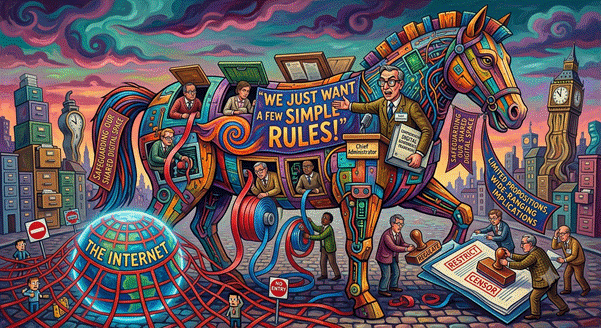
The gift at the gate
The Greeks did not take Troy by force. They took it by leaving a gift the defenders could not bring themselves to refuse — and by hiding inside it the army that would do the actual work. The Human Rights Commission’s submission on the Deepfake Digital Harm and Exploitation Bill follows the same design.
At the gate it places something sympathetic and hard to turn away: support for a narrow law criminalising the creation and distribution of non-consensual deepfake imagery.
Concealed within that endorsement is something else entirely — a comprehensive “system-level” regime for governing artificial intelligence and digital platforms, complete with pre-emptive bans, mandatory design controls, proactive content screening, and a standing apparatus of unelected oversight.
The submission asks to be read as a single argument, in which accepting the gift means admitting the army. It is not one argument. It is two, and the second has been built to ride in on the moral authority of the first.
The Bill on its own terms
The amendment, taken by itself, deserves support, and saying so is not a concession to anything that follows — it is the whole point of insisting the two be kept apart.
Non-consensual deepfake imagery is a real and serious wrong, and the law has lagged the technology that produces it. The Bill does what sound criminal law does: it names a specific wrong, locates the person who commits it, and attaches a consequence, working after the act through the ordinary processes of the courts.
It is narrow, targeted, and self-contained. It demands nothing of the wider technological ecosystem beyond what is needed to punish the conduct it prohibits. On its own — which is the only honest way to judge it — it is a sensible closing of a gap in the law, and nothing in what follows is an argument against it.
One feature of the Bill matters more than it first appears. The Bill is not a prior restraint on expression. Prior restraint — the principle, central to free-expression law and reflected in the right affirmed by section 14 of the New Zealand Bill of Rights Act 1990, that the state should be especially reluctant to suppress expression before it occurs — is about stopping speech at the source, before any court has found it unlawful.
The Bill does the reverse: it defines an offence, sets a penalty, and leaves guilt to be determined by a court after the conduct has happened. That is subsequent punishment in its plainest and most defensible form. Hold onto this, because it is the very line the cargo inside the horse is built to cross.
Opening the horse
The moment the Bill is endorsed, the submission turns it into a pretext. The Bill, it says, is a “necessary first step” but “inherently reactive and limited,” incapable on its own of reaching the “systemic drivers” of harm.
From this single observation the submission extracts an entire legislative programme: bans on “high-risk” AI tools, mandatory safety-by-design, proactive platform detection and removal duties, new independent oversight bodies, national impact-assessment frameworks, and a permanent regime for governing digital technology at large.
The lever is always the same sentence, repeated in different clothes: because the Bill cannot do everything, the Commission’s entire architecture must be adopted. The premise is trivially true — no criminal provision addresses every facet of a complex harm. The conclusion is a leap across a chasm. That a narrow law leaves adjacent problems unsolved is not a licence to bolt a sweeping system of control onto it.
This is the manoeuvre in full, and it should be named as a manoeuvre. The deepfake offence is the wooden horse — unobjectionable, sympathetic, almost impossible to vote against.
The systemic regime is the force concealed inside it: contentious, expansive, and of a wholly different nature.
By fusing the two into one submission, the Commission engineers a situation in which a legislator who accepts the obvious case for the offence is invited to wave the entire apparatus through the gate behind it. The fusion is not an accident of drafting. It is the strategy. A proposal confident of winning on its own merits does not need to arrive disguised as something else.
Different in kind, not degree
The two proposals are not two sizes of the same idea; they are opposites in structure.
The Bill is individualist to its core. It keeps two real people in view — the victim who is owed a remedy and the perpetrator who must answer for the wrong — and works through ordinary adjudication, after the fact, against an identified wrongdoer.
The systemic regime is collectivist to its core. Its subjects are not persons but systems, platforms, populations and design; its instinct is to forestall categories of harm rather than to judge particular wrongs, and to do so in advance, across the whole ecosystem.
Supporting the first commits one to nothing in the second. A person can believe that whoever fabricates a degrading image of another should be prosecuted, and believe with equal force that the state should not thereby acquire a roving mandate to pre-screen the technologies and platforms through which lawful expression also moves. These are separate questions. The submission’s entire method depends on you never noticing that they are.
What the army is built to do
Judged on its own, the systemic regime is not a benign extension of the Bill but a far costlier instrument.
It begins by dissolving responsibility. Its signature move is to shift the burden, in its own words, from individual victims onto “systems and institutions” — which, dressed as compassion, also lifts the gaze from the wrongdoer.
A deepfake is not produced by a system. It is produced by a person who decides to produce it. Spread that responsibility across developers, platforms, regulators and “society as a whole,” and the perpetrator simply vanishes into a flow-chart while the vocabulary of guilt is swapped for the vocabulary of risk. A regime that cannot point at the wrongdoer cannot hold the wrongdoer to account — which is the one thing the Bill, left alone, does cleanly.
It governs, next, by abstraction. The regime is assembled from elastic terms — “high-risk” technologies, “harmful” applications, “safety-by-design,” “intersectional harms” — each of which looks reassuring in a submission and operates as a blank cheque in a statute, because each hands the power of definition to whoever applies it later. A ban on “high-risk AI tools” extends precisely as far as some future official decides high risk extends, and the submission proposes that official sit in a new and independent body whose writ runs across “all relevant laws and regulations.”
The result is a wholesale transfer of policy from an elected Parliament to expert and administrative institutions whose discretion is broad and whose accountability to the public is faint.
And it expands without natural limit. A regime introduced under the banner of deepfake abuse would in practice reach across the digital economy — platform liability, proactive detection and removal duties, compulsory design standards, perpetual monitoring — binding a vast field of lawful activity and lawful speech that has nothing to do with the harm that justified it.
The weight of compliance lands hardest on those least able to carry it, the smaller developers and platforms, entrenching the largest incumbents and smothering the competition the Commission claims to want disciplined. Beneath all of it lies the standing pathology of collectivist regulation: the elevation of the group over the person.
A system built around community resilience, collective complaint and systemic redress is, by construction, indifferent to the individual interests a free society guards most fiercely — the freedom to speak, the right to due process before condemnation, and the presumption that what is lawful stays permitted until a specific wrong is proven.
Once the governing question becomes “how do we shield the collective from a category of risk?” rather than “has this person wronged that person?”, individual liberty and individual accountability are both quietly written out.
Pre-emptive speech control — the cargo named plainly
Separating the two proposals exposes the thing the bundling is designed to hide: at its core, the systemic regime is a machine for restraining expression before it happens.
The Bill, as established, punishes after the fact and raises no prior-restraint concern. The regime does the opposite at point after point.
Banning “nudification” apps and other “high-risk” tools restrains a means of expression before any particular expressive act occurs, on the strength of harm the tool might one day enable. Mandating safety-by-design alongside proactive detection, moderation and removal conscripts private platforms into filtering expression at or before publication — automated screening at scale, with no court having found a single item unlawful.
Strip away the language of safety and this is prior restraint, whatever doctrinal label is withheld from it.
The classic prior restraint is a licence or an injunction against a named publication; a blanket tool ban or a design mandate is a step removed in form but identical in direction and in vice. It silences in advance. It is structurally over-inclusive, because a filter or a ban cannot perform the discrimination a court performs between the unlawful instance and the lawful one.
And it removes the judicial guard that is supposed to stand between the state and the suppression of speech, handing that power instead to private intermediaries who censor pre-emptively to avoid liability.
This is the precise contrast the horse is built to obscure: the measure you are asked to admire sits safely on the subsequent-punishment side of the line, while the regime hidden behind it marches across into pre-emptive control — and asks to do so without ever facing the scrutiny such a crossing demands.
Refuse the horse
The tell is the disguise itself. A regime of pre-emptive speech control, vesting open-ended discretion in unelected bodies and pressing private platforms into censorship before any court is involved, is exactly the kind of proposal that ought to be argued in the open, on its own evidence, through its own process, and made to stand or fall on its own merits.
The Commission has chosen not to do that. It has instead loaded the regime into the hull of a deepfake offence and rolled it toward the gate, betting that the urgency of the genuine harm will carry the apparatus past examination. That choice of method is not a detail to be excused; it is the strongest reason to distrust the cargo. A case that has to enter in disguise is announcing that it could not get in any other way.
The right response is therefore the simplest one. Support the deepfake amendment for exactly what it is — a narrow, sound, self-contained closing of a gap in the law — and refuse, flatly, to let the Commission’s wider regime ride in on its back.
If there is a case for system-level regulation of artificial intelligence and digital platforms, let its authors wheel it up to the gate in the daylight and defend it as itself.
Until they do, the only safe course is the one the Trojans failed to take: open the horse before it is inside the walls.
