
Reading Reflections
How A Book in the "Antilibrary" Started a Journey

Too many books. Not enough time.
Umberto Eco coined the term the “antilibrary” – the collection of unread books in one’s home. Eco argued that unread books are more valuable than read ones, as they represent a “research tool” and a source of knowledge you have yet to acquire.
I offer this as an introduction to illustrate how a journey may start and where it leads.
I came across America author Michael Lewis when I was starting to teach Law and It at Auckland University. He published a book “The New New Thing” in 1999 and it seemed to fit with how I envisaged the course.
The book was about Jim Clark, a Silicon Valley entrepreneur who founded three billion-dollar companies - Silicon Graphics, Netscape, and Healtheon.
The book used Clark as a lens to examine the culture and psychology of Silicon Valley during the late 1990s dot-com boom. They were exciting times. The pace of change was relentless. Digital technologies were challenging the existing paradigm. Disruption was the name of the game.
The title “The New New Thing” referred to the relentless Silicon Valley obsession with whatever comes next — the idea that hasn’t been thought of yet, the technology that will disrupt everything. Lewis captured the strange moment when technology entrepreneurs became the most powerful people in the world, and when ideas with no revenue could be worth billions.
I enjoyed the book and Lewis kept on writing about business and technology. One of his books The Big Short was made into a movie – a stunningly gripping story of the 2008 global financial crisis and how a small group of investors saw it and made enormous bets that the US housing market would collapse.
The background was that in the mid-2000s, the American housing market was booming and almost everyone - banks, regulators, ratings agencies, investors - believed it would keep rising.
A few outsiders dug into the data, discovered that the mortgage system was built on a foundation of terrible, fraudulent loans, and found a way to short (bet against) the housing market. When it crashed, they made billions.
The book explained the staggering complexity and opacity of financial instruments like CDOs (collateralised debt obligations – a financial product that bundled together a large pool of loans or debts and then sold slices of that pool to investors) and mortgage-backed securities — which even the people selling them didn’t fully understand.
The 2015 film adaptation directed by Adam McKay is excellent and very faithful to the book, starring Christian Bale (as Michael Burry an eccentric hedge fund manager who spotted the problem), Steve Carell (as Steve Eisman a Wall St analyst who became outraged at the corruption he saw in the mortgage industry), Ryan Gosling, and Brad Pitt. It uses creative techniques like having celebrities break the fourth wall to explain complex financial concepts.
It’s arguably Lewis’s most important book — a gripping, accessible explanation of one of the most consequential economic events in modern history. But it links back to the book that started Lewis on the road.
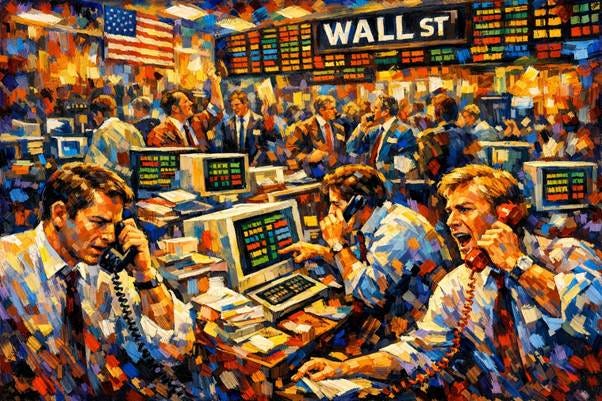
His first book Liar’s Poker shot him to fame for its expose, analysis and description of the Wall St culture of the 1980’s. It is based on his own experience as a bond salesman at Salomon Brothers, one of the most powerful investment banks of the era.
Lewis graduated from Princeton with an art history degree and earned a Masters in economics from the London School of Economics. The first degree was not an obvious path to Wall Street. The second was.
Through a chance encounter at a dinner party he ended up sitting next to the wife of a Salomon Brothers partner, which led to a job offer. He spent three years there from 1985-1988 and the book is his account of what he witnessed.
The book opens with a famous anecdote. Liar’s Poker was a game played by Salomon traders using the serial numbers on dollar bills — bluffing about what digits you held. John Gutfreund, the CEO of Salomon Brothers, once challenged the legendary trader John Meriwether to a single hand for $1 million. It perfectly captures the testosterone-fueled, gambling mentality of the culture.
A central figure in the book is Lewis Ranieri, the Salomon trader who more or less invented the mortgage bond market in the 1980s — the same market that would eventually blow up the global economy in 2008. Lewis traces how this financial innovation created enormous wealth but also planted the seeds of future disaster, making Liar’s Poker feel remarkably prophetic in hindsight so reading the book after having read The Big Short (and seeing the movie) was a bit eerie.
Liars Poker was written partly as a warning in that Lewis expected readers to be horrified and felt that talented young people should avoid Wall Street. Instead it had the opposite effect and became something of a recruitment brochure, with young graduates wanting to live the wild life he described. He has reflected on this irony many times since.
Liars Poker had been sitting in my antilibrary for some time and I picked it up for a weekend read, and it was a fascinating experience. Not only for the story itself and the crystal clear way that Lewis discussed the development of mortgage bonds and junk bonds, but for the memories that it brought back. Sitting in the sun reading about the financial wheelings and dealings of Wall St in the 1980’s took me on a reverie to that time when I was in practice.
Today the 1980’s and especially the reforms introduced by the Labour Government are viewed with hostility. They were disruptive. They were radical. They were necessary.
People today who had not experienced life before 1985 may be critical but trying to manage what today we take for granted was an art form in itself. One example was connecting a telephone.
Telecommunications in the bad old days were run through the Post Office. It often took many weeks to get a home telephone connected – even if you were shifting house. Delays were dreadful. Bureaucracy ran riot. And the reality was that New Zealand’s economy in 1984 was genuinely dysfunctional and headed for a crisis. The reforms laid the groundwork for the relative prosperity of the 1990s and 2000s.
As a result New Zealand is consistently rated as one of the most open and least corrupt economies in the world, partly as a result.
The reforms effectively ended the post-war consensus that the state should directly manage the economy and protect workers and industries. That consensus has never been fully restored.
Every New Zealand election since has in some way been a debate about where to draw the line — how much state involvement, how much market, how much protection versus competition. The problem is that little by little the State has assumed a much greater role in everyone’s lives and is seen as the first port of call in a crisis rather than the last one. The current dependency culture at all levels of society (not just on the part of those in receipt of welfare) has rolled back many of the benefits of the reforms of the 1980’s.
And were the 1980’s a good time to be in legal practice. The floating of the dollar, the privatization of state-owned enterprises, the deregulation of financial markets, the reduction of import tariffs and trade protections, the flattening of income tax rates and the introduction of GST all provided new and wonderful opportunities for legal practice.
Before the reforms, there wasn’t a great deal of sophisticated corporate legal work in New Zealand because the economy was so heavily regulated and state-controlled. The reforms created a wave of privatisations requiring complex transactional legal work — selling state assets like Telecom, Air New Zealand, BNZ and others generated new approaches to new problems and by the way generated enormous legal fees.
Mergers and acquisitions activity took off as the private sector consolidated and foreign capital entered New Zealand and capital markets work expanded dramatically as financial markets were deregulated and the NZX developed. Listing companies on the exchange was a complex business, even in the deregulation period and I recall an innovative approach which was to purchase a low performing but listed company and transform its business operations. The new owners couldn’t wait to get on the trading board and this provided a way.
Foreign investment transactions required sophisticated legal structuring as overseas buyers entered the market.
In fact the deregulation of financial markets created an entirely new practice area almost overnight. New financial instruments and products needed legal documentation. Foreign banks entering New Zealand needed local legal counsel.
The Reserve Bank Act 1989 and its inflation targeting framework created ongoing regulatory legal work. Securities law became a serious and lucrative specialty and when the market crashed in 1987 there followed enormous litigation and insolvency work.
Before Rogernomics, a career in law in New Zealand meant largely conveyancing, wills, family law and small business work. After the reforms, a genuinely sophisticated commercial legal market emerged that could offer lawyers intellectually challenging, well-remunerated work that had previously only been available in London, New York or Sydney.
In that sense, the reforms were genuinely liberating for the legal profession even if their broader social legacy remains contested.
I was in litigation and had something of a speciality in family law and what was then called matrimonial property (now relationship property). Things were changing so fast that I had a computer in my desk and ran a spreadsheet program called Visicalc so that I could track the changing values of assets as share prices varied from day to day. Using that program meant that bottom lines automatically recalculated – a real innovation at the time but something well known to users of Excel today. It was very helpful in ensuring the best outcome for the client
The heady times of the 1980s created their own issues. Oliver Stone made a movie – an excellent movie – called Wall Street starring Michael Douglas as Gordon Gekko. The character of Gekko is said to be a composite of several people, including Dennis Levine, Ivan Boesky, Carl Icahn, Asher Edelman, Michael Milken.
And the film is famous for the use of the line “greed, for lack of a better word, is good.” The line was developed from a comment by Ivan Boesky who said at a Berkeley commencement speech “Greed is all right, by the way... I think greed is healthy. You can be greedy and still feel good about yourself”.
And there was corruption as well. Milken, Boesky, Levine and Martin Siegel were regarded as four men who nearly destroyed Wall St in a series of scams that made earlier insider deals looks like street corner hustles. The excellent book Den of Thieves by James B Stewart tells the story of all four. And it is fascinating stuff.
This was the reverie as I read Liars Poker. A reflection on a time gone by.
But I confess that business stories and business in general is something that I find interesting – how it works, how it comes together, what it does, the advantages and opportunities, the innovation and wondrous entrepreneurialism much of which is decried in our semi-socialist state.
One recent drama series that was on television was a show called Billions.
The show centred on the conflict between ruthless, brilliant, and charismatic Bobby “Axe” Axelrod (played by Damian Lewis) — a self-made billionaire hedge fund manager who grew up poor and built Axe Capital into one of the most powerful funds on Wall Street and Chuck Rhoades (brilliantly played by Paul Giamatti) — the US Attorney for the Southern District of New York, from an old money family, with enormous ambition to bring down financial wrongdoers — and specifically Axe.
Hey – a business show and a lawyer show – right up my alley.
The central tension for much of the early seasons was a cat and mouse game between these two equally matched, equally flawed men, each willing to bend or break rules to destroy the other.
In particular the show dealt with hedge funds - private investment funds that use aggressive, sophisticated strategies to generate returns for ultra-wealthy clients.
This world included analysts competing ferociously to generate investment ideas, traders making split-second decisions worth hundreds of millions, a culture of extreme wealth — private jets, Hamptons mansions, art collecting, the grey areas around insider trading and what constitutes legal versus illegal information gathering, the political connections that wealth buys and the performance pressure and the psychological toll of managing other people’s billions.
The Southern District of New York really is the most feared prosecutor’s office for Wall Street, and the dynamic between ambitious prosecutors and wealthy targets is real.
The show was reportedly inspired partly by the real-life conflict between Preet Bharara (the actual US Attorney for the Southern District) and Steve Cohen of SAC Capital, who was investigated for years for insider trading.
However, the personal vendetta element between Chuck and Axe was more dramatic than the way in which these things typically unfold and real hedge fund managers are generally less flamboyant and more careful than Axe.
But to be fair Billions was one of the better attempts to dramatise the world of high finance for a general audience. It was genuinely sophisticated about the culture and psychology of Wall Street even when it exaggerated the drama. At its best — particularly the first three or four seasons — it was a sharp, witty, morally complex portrait of how power, money and law interact in America. The later seasons lost some of that focus but it remained entertaining throughout.
For anyone interested in the themes of books like Liar’s Poker or The Big Short, it is very much worth watching.
One of the characters – one I found most entertaining – was Michael (Wags) Wagner played by David Costabile. He was Axe’s hard-partying, well connected, fiercely loyal chief operating officer who provided much of the show’s dark comedy.
Wags is described as the last hold-out of the old Wall St – the last wolf in wolf’s clothing by no less than Michael Lewis himself who is written into Billions in a cameo appearance to celebrate the 35th anniversary of Liars Poker
And in that way we come full circle – an antilibrary book about the ‘80’s to how the ‘80’s were to a 35th celebration of the book in a scene about the culture and attitudes that characterised Wall St in Liar’s Poker.
And here we are, although there is one last thing.
I surrendered to that vibe in 1986 and bought myself a 1986 BMW 325i – deep BMW blue that was sharp and peppy and sent a message at the time. A yuppie’s car. And I still have it and from time to time I take it out to stretch its legs. They were good times.

"Telecommunications in the bad old days were run through the Post Office. It often took many weeks to get a home telephone connected – even if you were shifting house. Delays were dreadful. Bureaucracy ran riot. And the reality was that New Zealand’s economy in 1984 was genuinely dysfunctional and headed for a crisis. The reforms laid the groundwork for the relative prosperity of the 1990s and 2000s."
Yet when moving house in 1990 the telco service contractor refused to connect us on settlement and possession Friday. It was only because I happened to meet the telco head office counsel at a function and kept his phone number and used it that the contractor changed his mind. It's always and for ever not who you are, it's who you know
Was what you describe part of the sub-prime scandal?