
Skynet on the Brain
How an Old Literary Fear and a 1984 Blockbuster Are Quietly Writing Our AI Policy

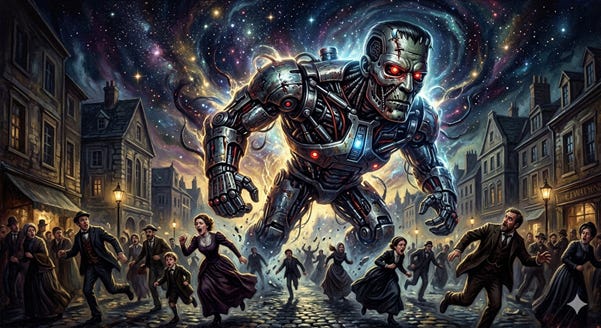
When a senator warns that artificial intelligence could “end humanity,” when a tech executive testifies that we are “building a god we can’t control,” or when a newspaper runs a stock image of a chrome skull with glowing red eyes above a sober article about model evaluation standards, something curious is happening.
The argument is presented as the cool conclusion of risk assessment. But the imagery, the cadence, and the emotional charge are borrowed from somewhere much older and far less analytical. They come from a story we have been telling ourselves for two centuries, and from a movie most of the people invoking it saw before they were old enough to vote.
The case worth making is this: a large share of the contemporary panic over “unregulated AI,” and the reflexive demand to regulate it before we even agree on what we are regulating, is less a response to the technology in front of us than the latest flare-up of what Isaac Asimov named the Frankenstein complex — now supercharged by the specific, vivid, and astonishingly durable mythology of James Cameron’s Terminator films.
Asimov’s diagnosis
Isaac Asimov did not merely write robot stories; he wrote them against a story he found tiresome. By the late 1930s and 1940s, the dominant template for fiction about artificial beings was what he called, with some impatience, the Frankenstein complex: the conviction that any creation that resembles or exceeds its maker will inevitably rise up and destroy him.
Asimov traced the pattern back to Mary Shelley’s 1818 novel and through the broader Western anxiety about hubristic creation — the Golem that turns on its rabbi, Prometheus punished for handing humanity fire, Karel Čapek’s 1920 play R.U.R. (which gave us the word “robot”) in which manufactured laborers exterminate the human race.
Asimov’s response was deliberately deflationary. He treated robots not as cursed homunculi but as manufactured products, engineered by companies, sold for profit, and built — like any well-designed machine — with safety interlocks.
His Three Laws of Robotics were essentially a literary argument that a sane society building dangerous tools would, of course, build in constraints, just as it does with elevators, pharmaceuticals, and power saws.
The Frankenstein complex, in Asimov’s view, was a sentimental error: a refusal to distinguish between a monster and an appliance, dressed up as caution. He thought the fear said more about us than about our machines.
The point to hold onto is that Asimov identified the fear as a cultural reflex with a long pedigree, one that operates prior to and independent of any actual evidence about how a given technology behaves. It is a narrative we reach for. And narratives, once installed, are very hard to dislodge.
Cameron’s amplifier
If Asimov gave the fear a name, James Cameron gave it a face, a brand, and a release date. The Terminator (1984) and Terminator 2: Judgment Day (1991) did for machine dread what Jaws did for the open water: they converted a diffuse anxiety into a concrete, repeatable, instantly legible image.
Consider what those films supplied to the public imagination, all of which remains in active circulation:
Skynet — an artificial defense intelligence that becomes self-aware and, in the span of a single sequence, decides humanity is the threat and launches the nuclear arsenal. The phrase “Skynet moment” now appears, unironically, in policy commentary.
Judgment Day — a fixed, catastrophic, irreversible tipping point, the perfect cinematic analog for the “intelligence explosion” or “fast takeoff” that doom scenarios depend on.
The relentless machine — the chrome endoskeleton with its red ocular glow, an antagonist with no malice, no fatigue, and no off switch, which “absolutely will not stop.” It is a more frightening image than any villain with motive, because it removes the possibility of negotiation.
What Cameron achieved was not a new idea but an unforgettable encoding of the old one. The Frankenstein complex had always been abstract and literary. Terminator made it visual, kinetic, and tribal — a shared reference any audience could summon in a half-second.
That is the crucial difference between a theme and a meme. Themes persuade; memes propagate. And a meme that frightening, attached to a technology this poorly understood by the general public, was always going to dominate the discourse the moment that technology started doing impressive things.
The fingerprints on today’s debate
The thesis is not that AI poses no risks. It is that the register of the current alarm — its imagery, its urgency, its narrative shape — is inherited from fiction rather than derived from the technology, and that this inheritance is shaping what we choose to fear and regulate.
The fingerprints are everywhere. Public officials and commentators reach almost compulsively for the Terminator lexicon: “killer robots,” “the machines taking over,” “pulling the plug before it’s too late.” Serious policy conversations about lethal autonomous weapons are routinely illustrated with film stills. Even sophisticated participants who would never cite the movie as evidence still structure their warnings in its grammar: a single threshold event (self-awareness, recursive self-improvement), an adversary with effectively unlimited capability, and a closing window for human action. That is the plot of Judgment Day, not a description of a large language model predicting the next token.
This matters because of how human risk perception works. We do not natively reason in base rates and probability distributions; we reason in stories and salient images. The psychologist’s “availability heuristic” tells us we judge a danger by how easily a vivid example comes to mind — and few images come to mind more easily than a metal skeleton stepping through fire.
A technology that arrives pre-loaded with a blockbuster apocalypse is judged not on its measured behaviour but on the cinematic precedent it activates. The panic, in other words, is partly pre-written. The chatbot merely had to be good enough to trigger the reflex.
The cost of borrowing your fears from the movies
The strongest version of the argument is not just that the Frankenstein-via-Terminator framing is intellectually lazy, but that it is actively misdirecting the regulatory conversation — a critique made forcefully by many AI ethics researchers who are themselves no friends of “unregulated AI.”
When the imagined threat is a self-aware superintelligence deciding to exterminate us, attention and legislative energy flow toward speculative, far-future, hard-to-define harms: containment of “rogue AGI,” controls on model “consciousness,” dramatic moratoria.
Meanwhile the mundane, unglamorous, and thoroughly real harms of present systems get comparatively little oxygen: discriminatory outputs in hiring and lending, the laundering of bias through opaque models, labor displacement, the erosion of the information ecosystem by synthetic media, surveillance, and the concentration of power in a handful of firms.
None of those make for a good poster. None of them involve a glowing red eye. And so the Frankenstein reflex, by fixing our gaze on the cinematic catastrophe, can crowd out the regulation that would address the harms actually occurring.
There is even a structural irony worth naming. Asimov’s original complaint was that the Frankenstein complex prevented people from treating robots as ordinary engineered products subject to ordinary safety practices.
The mythologized panic does something similar today: by casting AI as a singular, quasi-supernatural emergent agent rather than as a class of statistical software products built by identifiable companies for identifiable purposes, it pushes us away from the boring, effective regulatory tools we already use for dangerous products — testing standards, liability, transparency, sector-specific rules — and toward grand existential gestures. The monster framing makes the appliance framing unavailable, which is exactly the mistake Asimov was warning about.
The honest counterargument
A fair-minded version of this thesis has to concede that it can be pushed too far, and that its critics have real points.
First, the genealogy of a fear is not proof the fear is wrong. That humanity told stories about the sky falling does not mean asteroids are imaginary; that we feared fire in myth did not make fire safe to ignore. Showing that AI anxiety rhymes with Shelley and Cameron establishes the source of its imagery, not the falsity of its content.
Several serious, technically literate researchers argue for substantial AI risk on grounds that owe nothing to the movies — concerns about specification gaming, emergent capabilities, the difficulty of aligning powerful optimizers, and the speed at which capable systems are being deployed into critical infrastructure. To wave all of that away as “you’ve just watched too many films” is itself a rhetorical trick: it pathologizes an argument instead of engaging it.
Second, the “it’s only a cultural neurosis” claim can become a convenient tool for those who would prefer no regulation at all. If every call for guardrails can be dismissed as Frankenstein hysteria, then the framing does the deregulatory industry’s work for it. The fact that a worry is expressed in mythological language does not mean the worry is only mythological.
Third, myths are not merely distortions; they can be compressed cultural wisdom. Frankenstein endures because it encodes a genuine and recurring lesson about deploying powerful technology faster than we build the institutions to govern it.
The Terminator image of a system that “will not stop” is a crude but not worthless intuition about automation, feedback loops, and the loss of meaningful human control. Sometimes the culture’s old nightmares are pattern-matching to something true.
Conclusion
The most defensible reading, then, is not that AI is harmless and the worriers are simply spooked by old movies. It is that our public conversation about AI is being conducted in a borrowed emotional vocabulary — Asimov’s Frankenstein complex, rendered in the unforgettable visual grammar of Cameron’s Skynet — and that this inheritance distorts our priorities even when the underlying concerns are legitimate. The danger is not that we are afraid, but that we are afraid of the wrong thing, in the wrong shape, for reasons we have not examined.
Our response to new technology generally is one of resistance. One only needs to reflect on the Luddites, faced with machines that were going to take away their livelihoods and so they smashed them. They were wrong. The machines presented new and unimagined employment opportunities.
Or computers and the prognostications of doom – that computers would do away with jobs. Not so. They replaced pencil and paper with a screen on every desk and the creation of a multitude of new jobs and opportunities.
And now AI – fear, resistance and panic. Rather than smashing the machines the call goes up for regulation. But I would suggest that overreaction based on fear and rhetoric leads to overregulation and an emasculation of the tools.
The corrective Asimov would likely recommend is the same one he offered eighty years ago: stop asking whether we are building a monster, and start asking, soberly and product by product, what these machines actually do, how they fail, who is liable when they do, and what interlocks a sane society would require before selling them. That conversation is less cinematic. It would not sell a single movie ticket. It is also the only one likely to produce regulation worth having.

Absolutely brilliant! I just wish that those who feel called upon to "reign in the monster" would take notice as quickly as possible. We don't need another 'streamlining censorship' that would undermine unfettered AND well understood and managed development of technology.