

Thy Naiad airs have brought me home
To the glory that was Greece,
And the Grandeur that was Rome
Edgar Allan Poe
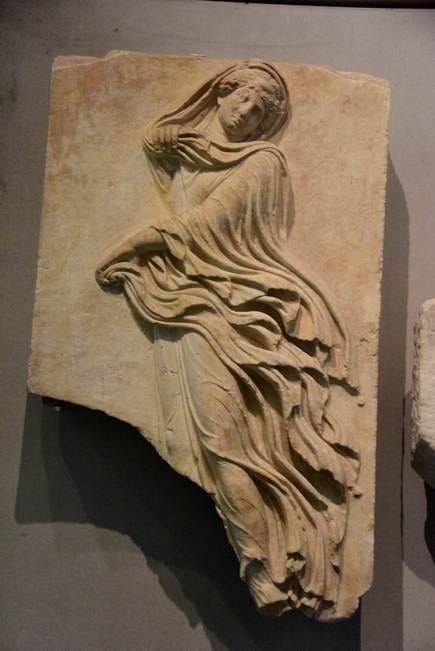
Silently she is frozen in stone, her head turned over her left shoulder as if to look for something that had passed whilst the breeze catches her garment, making it flow across and behind her as she moves yet is static.
Another like her bends to fasten her sandal.
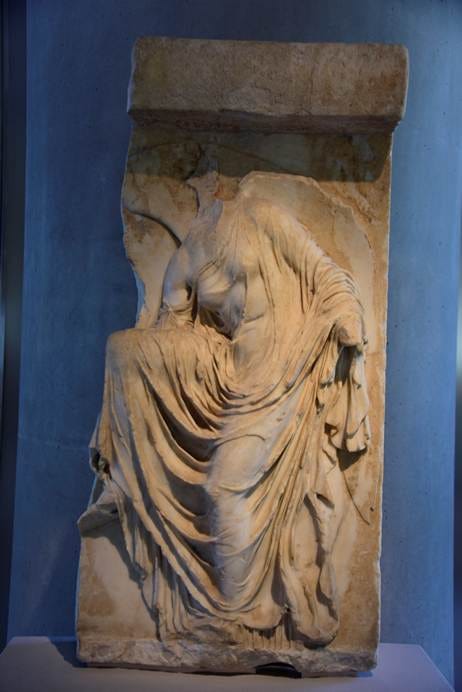
Balancing while she does so, the folds of her robe drape over her left arm and over her raised knee. Is she balancing? It would seem so for there is nothing nearby for her arm to rest upon. Maybe she is resting her sandalled foot against a stone to steady it as she tightens an errant lace.
These are images from the deeps of time – or to one from our country they are the deeps of time for our time, our history and the blending of cultures that make up our homogeneous mixture, is not deep.
Indeed if anything our culture remains splashing in the shallows beside the developed, mature, philosophical polis that was Athens in the Fifth Century BC – the days of Pericles when the wonder of the Parthenon was built to honour and glorify Athena Parthenos, the protectress of the city.
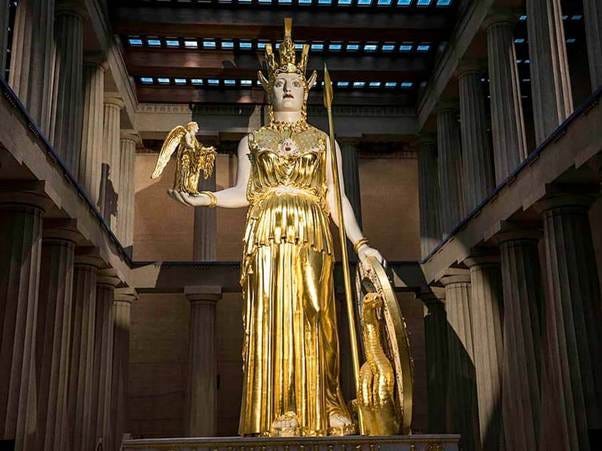
The temple housed a massive 12-meter-tall chryselephantine (gold and ivory) statue of Athena, sculpted by the renowned ancient Greek artist Phidias and every year it was redressed by a grateful citizenry.
The temple was constructed to proclaim to the world the success of Athens as leader of the coalition of Greek forces in the Persian Wars.
The cult statue, begun in 447 BCE and dedicated in 438 BCE, would remain the great city’s symbol for a thousand years until, in Late Antiquity, it disappeared from the historical record, possibly taken to Constantinopolis and there later destroyed.
Fortunately, copies and representations, the most complete being the 2nd century CE ‘Varvakeion statuette’, of the statue and some of its sculptural details, along with descriptions by Plutarch and Pausanias, allow us to fairly accurately reconstruct its original appearance.
But it is not just the Parthenon that honours the Goddess. The city itself does so.
We call it Athens but the signs on the road and in the maps in Greek name the city for the Goddess - Ἀθηνᾶ in the ancient script and Αθηνά in the modern.
The starting point must be the Parthenon for it dominates the Akropolis and is constantly visible from the Akropolis Museum across the road. It is a presence it itself and it is one of the magic moments when dining in any one of the nearby restaurants to look up into the fading dusk and see the Parthenon lit up.
There is a moment, standing below the Parthenon, when the building stops looking like architecture and starts looking - unusual. Every line that appears straight is in fact curved. The stylobate — the platform the columns rest on — swells upward at its centre by roughly eleven centimetres along its length, so that it will not sag to the eye the way a truly flat surface does.
The columns lean fractionally inward. If they were extended into the sky, they would meet more than a mile above the temple. Each column tapers with a subtle convex bulge, the entasis, calibrated so the shaft reads as taut rather than pinched.
Nothing here is accidental. The Parthenon is a machine for correcting the errors of human vision, built by people who had thought harder about how seeing works than about how stone behaves but who also had enough understanding about perception and perspective and the mathematics necessary to make it work.
Between 447 and 432 BCE, under the political dominance of Pericles and the artistic direction of Pheidias, with Iktinos and Kallikrates as architects, Athens produced this thing. How they did it is a marvel of creativity, vision and opportunism
The machine beneath the marble
The romantic account of Periclean Athens — genius, democracy, the human spirit unbound — is not false. It is perhaps the most interesting and important part of the story.
Genius is distributed fairly evenly across human populations and human history. What is not distributed evenly is the set of conditions that let genius gather, specialise, and leave a durable monument.
Athens had an unusual concentration of those conditions, and the Parthenon is downstream of all of them.
The Athenians had money. The temple was raised, in significant part, on the tribute of an empire. After the Persian wars, the alliance of Greek states known as the Delian League placed its treasury on the sacred island of Delos; in 454 BCE that treasury was moved to Athens, and Athenian leaders spent a portion of it beautifying their own city.
The allied states were, in effect, taxed to build a monument to Athenian pre-eminence, and contemporaries said so with some bitterness. Beneath that lay the silver of Laurion , the mines - again under Athens’ control in southeastern Attica whose ore had already, a generation earlier, paid for the fleet that broke the Persians at Salamis.
Silver, tribute, a cash-cropping economy of olive oil and wine sold across the Mediterranean, and the ceaseless labour of enslaved people – for it was a reality of the time upon which we cannot, from this distance, pass judgement - who may have numbered a third of the population — this is the balance sheet the marble sits on.
Then add concentration. Athens was a genuine city, with tens of thousands of people packed into a small radius, connected by the Long Walls to its port at Piraeus.
Density is not a footnote to civilisation; it is close to its engine. Pack enough people together with enough surplus, and you can afford full-time specialists — sculptors who do nothing but sculpt, philosophers who do nothing but argue, masons who spend a career on optical refinements that no dispersed society could ever justify feeding a person to perfect. The division of labour that a dense, wealthy city permits is the quiet precondition for virtuosity in any single craft.
Add the alphabet to the mix. Writing. Literacy. The Greeks had adapted a Phoenician script into a full alphabet with vowels, and by the fifth century a substantial fraction of citizens could read. Writing is a technology for accumulation: it lets a thought outlive the person who had it and perpetuates and preserves it for others in a way that oral culture does not. Writing preserves memory and provides a record for future generations.
It lets a mathematical proof or a play or a treatise be corrected, transmitted, and built upon by strangers across generations. Athenian intellectual culture — the tragedies of Aeschylus, Sophocles, and Euripides performed to civic audiences of thousands; the philosophy that would run from Socrates through Plato to Aristotle; the beginnings of history as a critical discipline in Herodotus and Thucydides — is inseparable from the fact that these people could write it down and argue with the dead.
Finally, add the peculiar political arrangement that made display compulsive. Athenian democracy, real in its rivalrous intensity which turned public life into a permanent competition for prestige. Wealthy citizens funded warships and drama festivals as a form of status warfare. The city itself competed with its rivals and its own past.
In that atmosphere, a monument was not decoration; it was a claim, staked in the most expensive and permanent medium available. The Parthenon is what happens when surplus, specialisation, literacy, and competitive display all point at the same limestone hill at the same time.
None of this diminishes the achievement. It explains it. And explanation is the , answer to the question how did this actually happen along with the inborn superiority and genius of the people who built it.
The Parthenon and the Akropolis are iconic. They are representative of Athens but are instantly recognisable. They dominate our cultural heritage in the same way that they dominate the Athenian skyline. Walking the stones and paths of the Akropolis is to follow in the footsteps of those who have made a contribution to our culture that far exceeds the size of the society from whence it came.
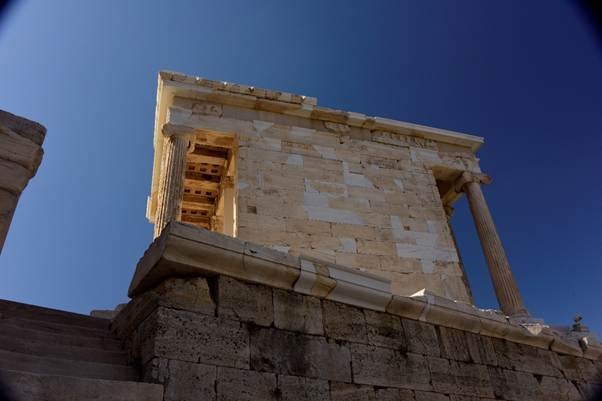
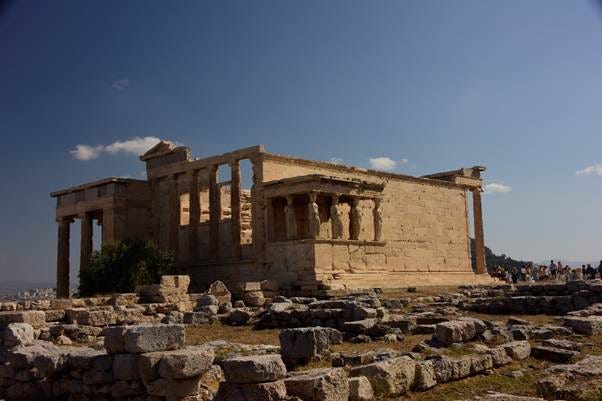
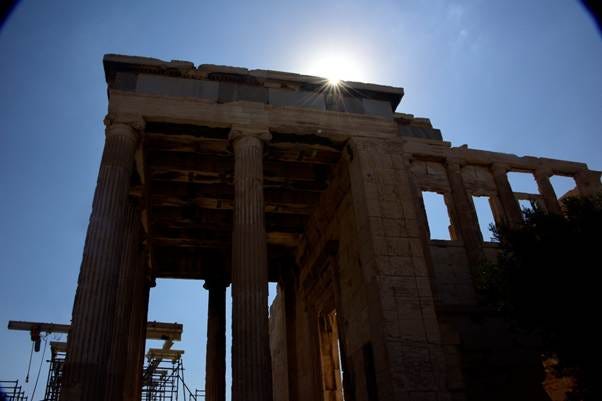
It was a wonder to stand on those stones and sense the deeps of time.

Many years ago I remember eating a late supper at a small taverna below the Parthenon and looking up I lost my breath at the sight of the lit-up Acropolis floating above me.
Beautiful essay. Thank you, you've done more to promote a trip to Greece than their tourism agencies combined.