
The Maduro Indictment
The Intersection of Law and Politics

Nicolás Maduro, the president of Venezuela who was captured in a military raid on Caracas, faces charges in the Southern District of New York, where prosecutors have targeted him for years.
The original indictment was obtained in 2020 when he was first charged with narco-terrorism and other crimes. The indictment recently unsealed and which can be seen in full here says he worked with traffickers to send cocaine from Venezuela to the United States.
The indictment is an interesting document and demonstrates some of the differences in criminal procedure between the United States and New Zealand.
We used to have indictments but no more. In the past they were used in cases where an accused was being tried by a jury but changes to criminal procedure in 2011 consigned the Law French word “indictment” to the dustbin of history and substituted it with the words “charging document”.
The charging document must contain 1 charge only and must include
(a) particulars of the defendant; and
(b) particulars of the person commencing the proceeding; and
(c) a statement by the person commencing the proceeding that he or she has good cause to suspect that the defendant has committed the offence specified in the charge; and
(d) particulars of the charge containing sufficient particulars to fully and fairly inform the defendant of the substance of the offence that it is alleged that the defendant has committed.
Normally a charging document is straightforward. For example it will charge that on a particular date and at a particular place the defendant assaulted John Smith. It will contain the section of the Crimes Act that relates to the offence. If it is more serious it may contain other details – for example “assaulted John Smith with intent to injure him”.
There is rarely, if ever, a recitation of the details of the offending, the events leading up to it or background information about the defendant. That comes out later – either in a summary of facts or in the witness statements that may later be filed to support the prosecution case.
In contrast the Maduro Indictment is a lengthy 25 page document that reads like a polemic as well as containing the particular charges that are faced by the defendants. Some of the material quite clearly is unproven, some of it is highly prejudicial, some of it is, at least to a New Zealand eye, irrelevant. It is, quite clearly, as much a political statement as it is a document setting out the charges that the defendants face.
Mr. Maduro, the indictment said,
“allows cocaine-fueled corruption to flourish for his own benefit, for the benefit of members of his ruling regime and for the benefit of his family members.
The defendant now sits atop a corrupt, illegitimate government that, for decades, has leveraged government power to protect and promote illegal activity, including drug trafficking, [which] has enriched and entrenched Venezuela’s political and military elite.”
The original 2020 indictment said that Mr. Maduro had come to lead a drug trafficking organization, the Cartel de los Soles, or Cartel of the Suns, as he gained power in Venezuela. Cartel de los Soles has been an ironic nickname for the Maduro administration’s military officers, who wear suns on their epaulets.
Though the circumstances of Mr. Maduro’s capture in a military raid were extraordinary, the American legal system has experience in arresting South American leaders and putting them on trial. Manhattan prosecutors have a saying — “you can’t suppress the body” — meaning that once a person is in custody, a case tends to move forward regardless of the circumstances of the arrest.
In 1989, the United States invaded Panama and compelled the surrender of Gen. Manuel Antonio Noriega, Panama’s military leader, who was taken to Florida and arrested by agents with the Drug Enforcement Administration. Three years after his surrender, Mr. Noriega was tried, convicted and sentenced to 40 years in prison.
In 2022, the former president of Honduras, Juan Orlando Hernández, was arrested by law enforcement officials from his own country in connection with a U.S. extradition request. He, too, was brought to the United States, where he was tried, convicted and sentenced. He was later pardoned by President Trump.
The case against Mr. Hernández and the 2020 charges against Mr. Maduro bear a significant resemblance. Both leaders were accused of using their governments as vehicles for the exporting of cocaine into the United States. And both were charged with conspiring to possess machine guns, which, combined with drug trafficking charges, carries potentially lengthy prison sentences.
The indictment is signed not only by the the United States Attorney but also by the foreperson of the Grand Jury which approved the indictment.
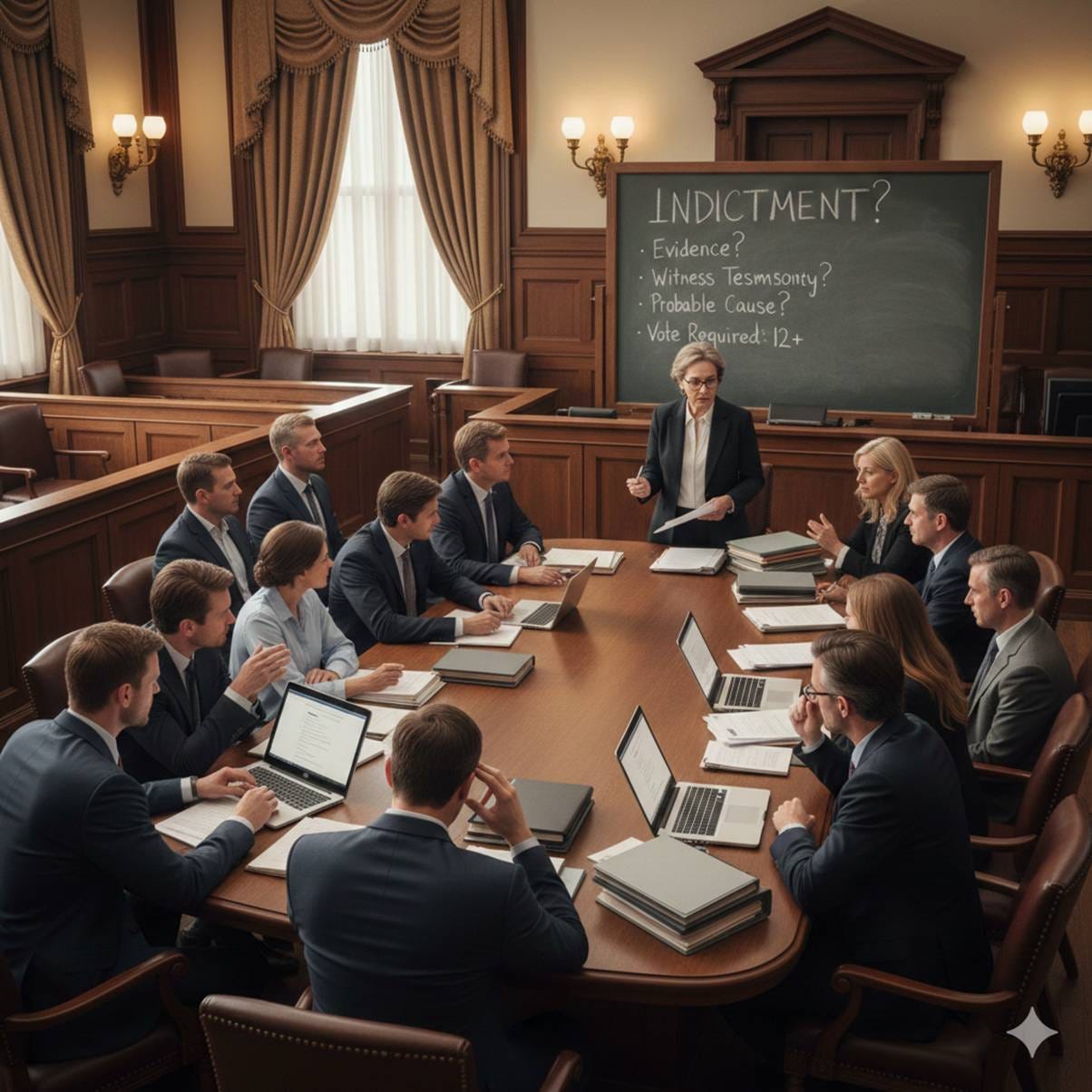
In the U.S. criminal system, an indictment is obtained through a grand jury process, which is primarily used for federal felony cases and in many state systems for serious crimes.
It typically works in the following way:
The Grand Jury: A grand jury consists of 16-23 citizens who meet in secret proceedings. Unlike a trial jury, they don’t determine guilt or innocence—they only decide whether there’s probable cause to believe a crime was committed and the accused committed it.
The Process: The prosecutor presents evidence to the grand jury, which might include witness testimony, documents, or physical evidence. The proceedings are one-sided—the defence lawyer isn’t present, the accused typically doesn’t testify, and there’s no cross-examination. The standard is much lower than at trial; prosecutors only need to show probable cause, not proof beyond a reasonable doubt.
The Decision: If at least 12 grand jurors (in federal cases) agree there’s sufficient evidence, they vote to issue a “true bill”—the indictment. If they don’t find sufficient evidence, they return a “no bill,” and charges aren’t filed.
It should be noted that not all cases require indictments. Prosecutors can instead file a criminal complaint and proceed through a preliminary hearing before a judge. The Fifth Amendment requires indictments for federal felonies, but many states allow prosecutors to choose between grand jury indictment and preliminary hearing.
The grand jury system has been criticized for heavily favouring prosecutors—there’s a saying that prosecutors could “indict a ham sandwich” if they wanted to—but it remains a cornerstone of the criminal justice system.
The Maduro Indictment
Based on recent developments, this is the history of the Maduro indictment:
The Original Indictment (March 2020) The initial indictment was filed and unsealed by the U.S. Department of Justice on March 26, 2020, during the first Trump administration. The case was filed in the U.S. District Court for the Southern District of New York. Then-Attorney General William Barr announced the charges, accusing Maduro and his associates of conspiring with the FARC (Colombian guerrilla group) to ship tons of cocaine into the United States.
The charges included narco-terrorism, conspiracy to commit narco-terrorism, drug trafficking, money laundering, and corruption. The U.S. Department of State offered a reward of $15 million for information leading to Maduro’s arrest.
The Superseding Indictment (January 2026) A new superseding indictment was unsealed on Saturday, January 3, 2026, by Attorney General Pam Bondi. This updated indictment charges Maduro, his wife Cilia Flores, his son, and others with:
Narco-terrorism conspiracy
Cocaine importation conspiracy
Possession of machineguns and destructive devices
Conspiracy to possess machineguns and destructive devices
The indictment alleges that for over 25 years, Venezuelan leaders abused their positions to import tons of cocaine into the United States, with Maduro at the forefront of this corruption.
Like most federal indictments, the indictment would have been obtained through a federal grand jury in the Southern District of New York. The prosecutors would have presented evidence to the grand jury showing probable cause that Maduro and his co-conspirators engaged in the alleged drug trafficking and terrorism activities. The grand jury would have then voted to return the indictment.
The indictment was unsealed after Maduro was captured in the U.S. military operation in Caracas and transported to New York. He made his initial court appearance on Monday, 5 January, 2026.
The grand jury existed in New Zealand from 1844 to 1961 when the Crimes Act 1961 was enacted, functioning to consider bills of indictment preferred against persons committed for trial and to decide whether the evidence against them justified their standing trial
From about 1880, the existence of the grand jury was strongly attacked and defended, with the essential dispute being whether it served a useful function. Critics argued that it merely reviewed what magistrates had already done well. However, the grand jury did sometimes save an innocent person from the ordeal of a trial, though it almost invariably acted on the suggestion of the Prosecutor.
After 1961 a preliminary hearing took place for a matter where there was to be a jury trial. This hearing was known as a depositions hearing and the tribunal – Justices of the Peace or a Magistrate – would hear prosecution evidence and determine if there was sufficient evidence for a case to be answered.
Deposition hearings were abolished in 2009. This change was part of reforms to improve efficiency and fairness in the criminal justice system.
After this date, committal for trial became determined on the basis of written statements rather than oral hearings, unless a successful application for oral evidence was made - which only occurred in about 3 percent of cases.
The removal of depositions resulted in an average of six weeks being cut from the time between when charges were laid and when a case was committed for trial, reducing it from about 100 days to around 60 days. This change also significantly reduced the stress on victims of crime who previously had to testify twice in the legal process.
Ultimately, the view prevailed that giving judges direct power to reject an indictment or a charging document would offer equal protection without the additional complications of a grand jury system.
Since the abolition of the grand jury in 1961, indictments and, after 2011, charging documents are presented directly to the Court by a legal officer of the Crown or by a private prosecutor.
This demonstrates some differences between the US system and that of New Zealand. Every criminal justice system has a different approach and no two are identical. What is interesting about the Maduro Indictment is that it is much much more than a means of placing certain charges before the Court. It has elements of a political polemic which may be interesting or useful in informing the public (now that it has been released). And one wonders whether or not that explains its length, verbosity and language.

Very interesting. My question is what jurisdiction does the US have over non-citizens/residents? I'm thinking to Kim Dotcom (rather than Noriega) - his extradition to the States while a citizen of NZ was decided by our courts, and they might have gainsaid it because the US has no jurisdiction here.
Very interesting.