
Unlawful
The UN Charter and the Iranian Conflict

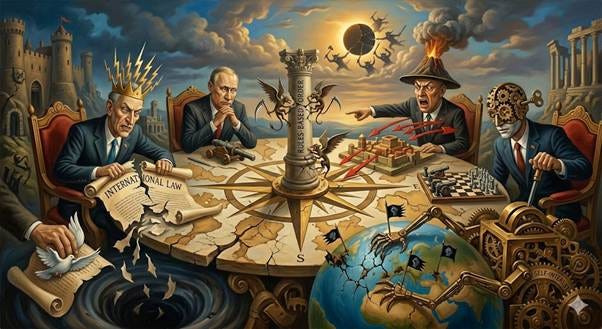
Helen Clark and latterly Phil Goff have criticized the Government for failing to condemn the attack on Iran by the US and Israel. Ms Clark condemned the Government’s approach as servile towards the US and a disgrace.
The main argument advanced by Ms Clark is that the attacks were illegal. And she wants the Government to endorse that approach.
Ms Clark argues that the question “was there an imminent threat to the security of the United States and Israel?” If the answer is no – as it would appear to be – then the attacks are an act of aggression.
I have a book on my shelf which I dusted off over the weekend. It is entitled “War and the Law of Nations – A General History” by Stephen Neff. As one would expect it is not a piece of light reading but it does provide some useful information on the issue of war.
I should immediately state that this is a highly complex and nuanced issue and one that has resulted in much ink being spilt over the centuries by academics and philosophers. International law and especially the law of war (if there is such a thing) is very complicated so what follows is a very simplistic analysis.
Modern international law defines a “lawful war” primarily through the UN Charter. This prohibits war but there are two exceptions – self defence under Article 51 and a war authorized by the Security Council.
The Rome Statute defines the crime of aggression – an unlawful war according to Ms Clark – as a prosecutable war crime.
Unlawful wars are those of conquest or aggression – such as the Russian conflict with Ukraine and pre-emptive wars without clear justification.
There have been a number of UN authorized military interventions.
In 1950 the Security Council authorized member states to defend South Korea after North Korea’s invasion. This was only possible because the USSR was boycotting the Council at the time and couldn’t veto it.
The period 1991 – 2011 – what could be described as the post-Cold War era – has been quite active.
In 1991 Resolution 678 authorized a coalition to expel Iraq from Kuwait. This is perhaps the most clear-cut example of the UN authorization system working as intended.
In 1992 – 93 Resolution 794 authorized US-led forces (UNITAF) to secure humanitarian aid delivery during the famine and civil war.
In 1994 Resolution 940 authorized a US-led force to restore the democratically elected government of Jean-Bertrand Aristide after a military coup.
In 1995 NATO airstrikes against Bosnian Serb forces were authorized under a series of resolutions, ultimately helping end the siege of Sarajevo and leading to the Dayton Agreement.
In 1999 Resolution 1264 authorized an Australian-led force (INTERFET) to restore peace after Indonesia-backed militias attacked following the independence vote.
In 1999 – 2000 Resolution 1270 authorized UNAMSIL, and later British forces intervened to prevent the RUF from overrunning the capital of Sierra Leone.
In 2011 Resolution 1973 authorized a no-fly zone and “all necessary measures” to protect civilians. NATO’s intervention went beyond what many members (Russia, China) felt they had agreed to, creating lasting controversy.
Currently in Mali from 2013 to the present Resolution 2085 authorized African-led and French forces to counter jihadist groups that had taken over northern Mali.
Again from 2013 through to the present Resolution 2127 authorized intervention to protect civilians amid sectarian violence in the Central African Republic.
Wars of Conquest or Invasion – which are clearly unlawful and unsanctioned by a UN Resolution include the Iraqui invasion of Kuwait in 1990. Iraq invaded and annexed a sovereign neighbor with no legal justification.
As noted the Russian invasion of Ukraine in 2022 provides another example. No credible self-defense argument existed under international law. The International Court of Justice ordered Russia to halt operations.
Other conflicts, the “lawfulness” of which has been contested include the US led invasion of Iraq in 2003. No UN Security Council authorization was obtained. The US argued pre-emptive self-defense based on alleged WMDs (which didn’t exist). Kofi Annan, the UN Secretary-General at the time, explicitly called it illegal. Most international legal scholars agree.
In 1999 the NATO intervention in Kosovo had no Security Council authorization due to Russian/Chinese vetoes. NATO justified it on humanitarian grounds (stopping ethnic cleansing of Albanians). Many scholars call it “illegal but legitimate” — the intervention achieved humane goals through unlawful means, highlighting a genuine gap in international law.
The Soviet invasion of Afghanistan in 1979 involved an intervention by the USSR to prop up a communist government. This was condemned by the UN General Assembly and was widely regarded as a war of aggression dressed up as fraternal assistance.
Israel’s various wars in Lebanon in 1982 was condemned by UN Resolution 509. The proportionality of the 2006 war was widely criticized as violating jus in bello principles.
Under the UN system there are some themes that become apparent. Great powers rarely face real consequences for unlawful wars due to veto power and political reality.
The line between unlawful war and lawful intervention is often genuinely ambiguous Kosovo being the best example.
Conduct during war is sometimes easier to prosecute than the decision to go to war itself and the international legal system is better at condemning unlawful wars than preventing them.
The essence of the argument between lawfulness and unlawfulness resolves itself around legal justification. Modern international law draws a sharp line between lawful uses of force and unlawful aggression, and most of the legal framework since 1945 is designed to prevent states from initiating war.
Initiation of force that does not fall within the UN Charter such as invading another state, launching attacks without justification, or using force for political or territorial gain is considered aggression, which is a crime under international law. This principle evolved from the post‑WWII Nuremberg Trials, where “crimes against peace” were prosecuted.
It is clear that in the case of the Israeli\US attacks on Iran the use of force is unlawful. There was no UN Resolution validating the attacks. There was no imminent threat.
It is clear from the US buildup of force in the region that the threat of force was being used to prompt a satisfactory outcome of negotiations surrounding on-going security issues in the Middle East including the termination of Iran’s nuclear programme.
It seems that a gathering of top Iranian officials presented an opportunity to take them and the Supreme Leader out and in that case the initiation of hostilities was opportunistic.
But opportunism does not equate with legality.
The problem is that the Rules Based Order so strongly favoured by Helen Clark and which acts as a protective umbrella for small countries such as New Zealand has gradually been deteriorating and has been replaced with power politics and elements of real politik.
The UN model was typical of the Rules Based Order but that “order” was only as good as the willingness of the Great Powers are prepared to abide them.
The reality is that most of the time China and Russia have not accepted the existence of such an order and the USA will invoke the order when it suits them. Recent developments suggest that the Rules Based order is not longer useful in terms of the strategic interests of the USA.
The Rules Based order will be invoked and relied upon by smaller states such as Australia and New Zealand and will probably be recast in the form of a revised collective security arrangement. Russia is a threat in the northern hemisphere and Europe. China is a threat in Asia and the Pacific. Security arrangements will have to recognise this.
The deterioration or collapse of the Rules Based order will revive realpolitik – something that has been a factor for decades but has not become quite as manifest as it is likely to become.
However, experience shows that realpolitik works best when objectives are limited and clear, and when it is firmly aligned with national interest. It requires clarity about material capabilities—hard power—and an understanding of how these align with the prevailing balance of power.
Such diplomacy also demands the capacity to anticipate second-order effects, including the reactions of competitors. At present, many decision-makers lack the ability to anticipate the impact of their policies.
Global rivalries have created a disequilibrium that is unlikely to be stabilized in the short term. The dominant trend in play works against the establishment of a stable balance of power. Yet, what the new balance of power will look like is the key question confronting us.
As the world sheds its illusions about the ethical superiority and desirability of a Rules-Based globalist order, gaining clarity about what a new balance of power looks like becomes of utmost importance.
As Clausewitz said war is a continuation of politics by other means. His view was that war is never autonomous; it is a tool of policy designed to compel the enemy to fulfill our will. The ultimate goal of military action is to disarm the enemy and destroy their capacity to resist.
Within her terms of reference Helen Clark is correct. The use of force against Iran is unlawful using a strict interpretation of the UN Charter. But the issue is more complex than that.
She ignores the fact that for decades Iran has been a disruptive force in the Middle East, determined to annihilate Israel. It has supported proxies and extremist militias in a number of neighbouring countries to further its policies and goals. And it has actively sought to develop a nuclear weapons capability which – given its rogue state approach – it could use in an unpredictable manner – well unpredictable only as to timing. The use of a nuclear weapon or weapons on Israel would only be a matter of time.
The other issue is the way in which the Government – and the Prime Minister in particular – have vacillated around the problem. Luxon’s performance at his Press Conference on 2 March 2026 was inept and a disgrace.
The best that the Government has been able to do is to suggest that Israel and the US may have information or intelligence that justifies their pre-emptive actions. But that does not prevent the Government from saying that on the information that is currently available the actions of Israel and the US are unlawful in terms of the UN Charter.
As for Ms. Clark and Mr. Goff – former politicians and now commentators. Perhaps with their superior wisdom rather than sniping from the sidelines and snarling across the airwaves if they think they can do better perhaps they may like to seek nominations from their political party and stand for a seat in Parliament.

A case could be made that Iran has been at war with Israel for the last couple of decades. Iran has utilised various proxies across the Middle East to attack Israel and has constantly called for "Death to Israel". Perhaps the 'war' didn't start a few days ago but twenty years ago and has now just entered a different phase. That doesn't make it legal but Iseal could argue"self defence"
David concludes “Within her terms of reference Helen Clark is correct. The use of force against Iran is unlawful using a strict interpretation of the UN Charter. But the issue is more complex than that.” It certainly is.
International law is not like law in the domestic law sense where it is, especially in a democracy and however imperfect, a reflection of the will of the people (except where unelected judges assume authoritarian powers), with established institutions for adjudication and enforcement. International law is more like a weapon to be used to advance other agendas. As I know from personal experience going back to the Vietnam War, the Labour Party is knee-jerk anti-American and almost as consistently a friend of left-wing dictators (not that Labour Party politicians have that on their own). Invocations of international law by Clark and Goff need to be seen in that light.
Regarding the law on war ably summarised by David, one wonders how the International Covenant on Civil and Political Rights affects the position. It commits nations to respect the civil and political rights of individuals, including the right to life, freedom of religion, freedom of speech, freedom of assembly, electoral rights and the right to due process and a fair trial. Iran ratified it in 1975, but blatantly and consistently violates the obligations it assumed. Where the interests of America and Israel in protecting their own citizens coincide with potential assistance to the citizens of Iran who are victims of tyranny in breach of the ICCPR, that may justify the use of force. It certainly means that Helen Clark’s terms of reference omit a vital component.