
Waitangi Week Perspectives
Contending Approaches to the Treaty

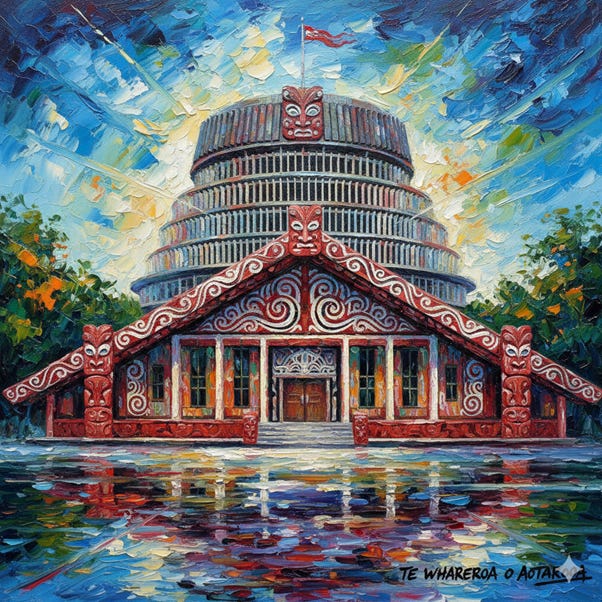
Chris Hipkins’ Waitangi Day — or perhaps Waitangi Week — article in the Herald on 3 February 2026 is a short piece, mercifully so at 562 words, and one suspects it was written by Hipkins himself rather than a speechwriter. Brevity, however, should not be mistaken for simplicity. In an election year, the article deserves to be read carefully, not only for what it says about the Treaty, but for what it signals about Labour’s wider philosophical direction.
At first glance, the article presents as a familiar reflection on national values framed through Te Tiriti o Waitangi. But early on, Hipkins reveals more than perhaps he intends. In his opening substantive paragraph, he declares: “The Aotearoa I know today is a proud collective of believers.”
The choice of the word “collective” is telling. It signals a worldview in which the individual is secondary to a larger social whole — a framing long associated with socialist thought, where personal interests are expected to yield to collective purpose, often mediated through the state.
This emphasis becomes clearer as Hipkins turns to values. He first describes them in broad, colloquial terms: having each other’s backs, working together, and “mucking in” for friends. He then restates the same ideas through a te reo Māori lens, invoking manaakitanga, kotahitanga, and kaitiakitanga. While the bilingual repetition may be rhetorically fashionable during Waitangi commemorations, it adds little to the substance of the argument. The values remain the same; only the vocabulary changes.
From there, Hipkins folds the Treaty into his narrative. Te Tiriti, he writes, is “not a relic of the past” but a living document that challenges each generation to recommit to fairness, partnership, and mutual respect. Honouring the Treaty, he insists, is not about division but unity “built on truth.” He concludes by describing Te Tiriti as a promise to be honoured, a foundation for the nation, and a pathway to a more united Aotearoa.
This is where the article begins to feel less benign. The assertion that Te Tiriti — as distinct from the Treaty — is the authoritative foundation of New Zealand’s future rests on a contested historical claim. The Treaty was first drafted in English and only then translated into Māori. The idea that the Māori text alone is determinative is a modern reinterpretation, heavily influenced by the jurisprudence of the Waitangi Tribunal, and one that rewrites history rather than clarifies it.
More importantly, Hipkins’ framing echoes earlier Labour-era proposals, particularly those contained in He Puapua. That document, developed while Hipkins was a senior member of the Government, set out an ambitious programme to implement the UN Declaration on the Rights of Indigenous Peoples. Its themes included Māori self-determination, expanded co-governance, race-based participation in state decision-making, and, ultimately, constitutional transformation toward a Tiriti-based governance model.
Under He Puapua, co-governance would extend well beyond Treaty settlements into areas such as resource management, climate policy, health, education, housing, and justice. The report envisaged parallel or shared governance structures, enhanced Māori consent requirements, and a state increasingly organised along bicultural — and therefore racial — lines. Hipkins’ description of the Treaty as a “living document” and “foundation” fits neatly within that framework, whether he names it explicitly or not.
Hipkins was not the only political leader to mark Waitangi Week in the Herald. The following day, David Seymour offered a starkly different interpretation. Where Hipkins emphasised collectives, Seymour emphasised individuals. For Seymour, the Treaty is best understood as a guarantee of equal rights, not race-based policy. He frames colonisation — including Māori colonisation — as a shared, if complex, national story that can unite New Zealanders as adventurous and entrepreneurial people.
Seymour’s argument rests on tino rangatiratanga understood as individual self-determination: the right of each person to live as they choose, so long as they do not harm others. His piece revisits themes familiar from the Treaty Principles Bill — now politically defunct, but philosophically clear. Rights, in this view, belong to individuals equally, not to groups differentiated by ancestry.
That contrast is the heart of the matter. Hipkins writes about unity, but his vision is grounded in collectivism, group identity, and governance structured around racial distinction.
Seymour writes about unity too, but locates it in individual liberty and equal rights before the law. One vision looks forward through personal freedom; the other looks inward through managed consensus and institutionalised difference.
To his credit, Hipkins has made his position clear. He has nailed his colours to the mast. Whether New Zealanders choose to salute them when they head to the polls on 7 November is, of course, another question entirely.

Good Morning New Zealand - a great day to celebrate each other, the country we live in, the communities we surround ourselves in and the journey that has brought us all here today! I'm a firm believer we (humans) are all inherently geared towards promoting our individual rights, yet many of the general populace are too scared to express those opinions openly or with conviction for fear of being 'othered' from a society that has been openly nudged toward collectivism ...... fear is such a great tool for control. Off to volunteer at the Rongotea Lions Club gala today with my family in tow, hard to beat a great day out with friends, neighbours and family. I hope you all enjoy however you choose to spend your day today. Kia-ora !!
And remembering Big Norm Kirk who declared this day be a nationwide day of unity 55 years ago. The fact that my wedding was celebrated 6 Feb 1971 is coincidental