
Walking Backwards Into the Future
Against Retrospective Thinking

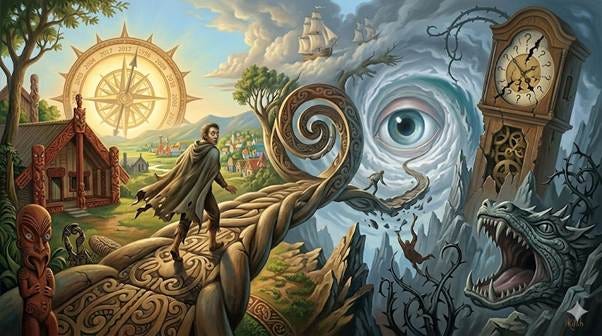
There is a striking similarity between two traditions of temporal thought that, on first encounter, appear to belong to entirely different intellectual worlds.
The Western media theorist Marshall McLuhan observed that human beings move into the future facing backwards — interpreting novelty through inherited frameworks, making sense of the unprecedented by analogy with the familiar.
An ancient indigenous proverb from the Pacific - Kia whakatōmuri te haere whakamua - expresses something structurally similar: one walks backwards into the future with one’s eyes fixed on the past.
Both images describe the same fundamental predicament of temporal consciousness. Yet the two traditions draw rather different conclusions from it — and in that divergence lies something urgent and consequential.
McLuhan’s formulation is, at its core, a warning about danger. The rear-view mirror is a limitation to be overcome, a cognitive trap that distorts our engagement with genuinely novel circumstances.
The indigenous conception, by contrast, presents this same orientation as a positive virtue — the presence of the ancestral past as a source of strength and identity rather than a distortion to be corrected.
This article argues that McLuhan is right and that the retrospective tradition, whatever its emotional appeal, is not merely incomplete but actively harmful in an era of accelerating change. The backward gaze is a problem to be solved, not a practice to be celebrated.
The Shared Predicament — and Why It Matters That We Transcend It
Both traditions begin from the same epistemological observation: we cannot apprehend the genuinely novel except through the conceptual resources we already possess.
When confronted with a new technology, a social transformation, or a cultural emergence, the mind reaches instinctively for analogy. The early automobile was a horseless carriage; the first films were moving pictures; radio began as wireless telegraphy; television initially broadcast stage plays. Each innovation was filtered through the assumptions of what preceded it.
The philosopher Edmund Husserl argued that consciousness itself is constituted through temporal horizons — a retention of the immediate past and an anticipation of what comes next — such that there is no unmediated present.
We do not merely happen to look backwards; the architecture of experience requires it. The retrospective tradition takes this observation and draws a comfortable conclusion from it: if we must look backward, let us embrace it, honour it, call it wisdom.
But this is precisely the wrong inference. The fact that a condition is deeply embedded does not make it desirable. Many of the most important achievements of human civilisation have consisted in overcoming tendencies that were, in some sense, natural or deeply structural. The backward gaze is a default to be fought, not a destiny to be accepted.
The Case Against Ancestral Inheritance
The tradition that presents the backward orientation as a positive inheritance makes several arguments that, under scrutiny, are either wrong or seriously overstated.
The first is the claim that identity is inherited and relational, that to sever oneself from ancestral continuity is impoverishment rather than liberation.
There is a kernel of truth here — human beings are social and historical creatures — but the conclusion drawn from it is dangerously conservative.
The history of moral progress is precisely the history of individuals and movements that refused the identities handed to them by inheritance. The abolitionist who rejected the social arrangements of their ancestors, the woman who refused the circumscribed identity bequeathed by patriarchal tradition, the scientist who discarded the cosmological assumptions of their forebears — these are not figures of impoverishment.
They are exemplars of what it means to engage honestly with the future rather than retreating into the past. The claim that inherited identity is constitutive rather than merely contingent has served, historically, as one of the most powerful tools for suppressing exactly this kind of moral and intellectual progress.
The second argument — that historical wisdom is practically valuable, that institutions encode hard-won knowledge — is plausible in stable conditions and dangerously misleading in conditions of rapid change.
Edmund Burke’s defence of tradition made a kind of sense in a world where the pace of change was slow enough that inherited arrangements could plausibly be presumed to encode accumulated wisdom.
It makes no sense in a world where the half-life of institutional knowledge is measured in decades, where the problems of the next generation bear no structural resemblance to the problems the inherited arrangements were designed to solve.
The legal framework that worked for an industrial economy does not work for a platform economy. The educational system optimised for the twentieth century workforce is not merely inadequate for the twenty-first; it actively miseducates, instilling rigidities and assumptions that obstruct rather than enable adaptation. Reverence for institutional inheritance, in these circumstances, is not wisdom but a guarantee of failure.
The third argument — that honouring ancestors grounds the obligation to care about future generations — is perhaps the most philosophically sophisticated, but it is also the most easily inverted. The claim is that because we are beneficiaries of past decisions, we should take seriously the claims of future people we will never meet.
But this argument does not require us to revere the past; it requires us to transcend it. The most important thing we can do for future generations is precisely not to pass on our inherited frameworks and assumptions as if they were authoritative.
It is to build institutions capable of learning, to leave open possibilities we cannot yet name, and to resist the temptation to bind the future to the past’s solutions. The obligation to posterity is an obligation to novelty, not to continuity.
The Real Stakes of the Backward Gaze
The risks of retrospective thinking are not merely theoretical. The historical record is littered with catastrophic consequences of the lag between inherited frameworks and present reality.
Legal frameworks designed for previous economic arrangements struggle to address emergent realities.
Educational systems optimised for industrial-era workforce requirements persist deep into the post-industrial age.
Political structures conceived in pre-digital contexts confront coordination problems their architects never anticipated.
These are not minor inefficiencies. They are system-level failures with enormous human costs — in poverty that persists because policy frameworks cannot perceive its new forms, in technological disruption that arrives unmanaged because regulatory imagination is trapped in the past, in democratic dysfunction that deepens because political institutions cannot evolve at the pace of the social changes they are meant to govern.
When the pace of change accelerates, this structural conservatism becomes dangerous in proportion to that acceleration. We are living through precisely such an acceleration.
The convergence of artificial intelligence, biotechnology, climate disruption, and geopolitical realignment means that the gap between inherited frameworks and present reality is not merely large but is growing faster than any tradition-oriented adaptation can close. In these circumstances, the retrospective orientation is not a resource. It is a liability.
There is also a more intimate risk that celebrations of ancestral inheritance consistently underplay. The ancestors whose guidance is invoked are not uniformly benign figures.
Every inherited tradition carries within it not only the wisdom of those who built well but also the injustices, hierarchies, and contested settlements of those who benefited from arrangements others did not choose.
To treat ancestral presence as an unqualified source of strength is to risk perpetuating exactly these injustices under the cover of cultural continuity.
The most serious critique of retrospective thinking is not that the past was without value but that it was also, and inseparably, without justice in many of its arrangements. An honest reckoning with inheritance demands a willingness to repudiate as well as to receive — and a tradition that presents the backward orientation as a positive virtue is structurally ill-equipped to make that repudiation.
History as a Tool of Power
The political dimension of retrospective thinking deserves particular emphasis, because it is here that its ideological function becomes most visible. Historical consciousness is never politically neutral. The attachment to the past that grounds identity and continuity can equally — and has historically been used far more often — to naturalise existing hierarchies, to delegitimise challenge, and to insulate established arrangements from transformation.
Every reactionary movement in history has appealed to ancestral authority, to the wisdom of inherited arrangements, to the disruption caused by those who would abandon the accumulated wisdom of the past.
This is not a coincidence. It reflects the structural logic of retrospective thinking: if the past is a resource and the future is uncertain, then the burden of proof falls on those who would change rather than those who would preserve.
McLuhan understood this. The rear-view mirror, in his account, is not merely a personal cognitive limitation — it is a mechanism through which power reproduces itself.
Media technologies do not merely transmit messages; they structure the perceptual frameworks through which reality is apprehended. The persistence of old perceptual frameworks in the face of new technological and social realities is not an accident; it serves the interests of those whose power depends on existing arrangements.
The indigenous proverb, whatever its original intent, functions within contemporary discourse as exactly this kind of conservatising force — a culturally prestigious framing of retrospective thinking that insulates it from the critical scrutiny it deserves.
The genuinely critical potential of historical thinking lies not in reverence for the past but in its capacity to reveal the contingency of present arrangements — to show that what appears natural or inevitable is in fact the product of specific historical choices that could have been made differently.
But this genealogical function is served precisely by the kind of forward-oriented critical thinking that McLuhan advocates, not by a proverb that instructs us to keep our eyes fixed on what lies behind.
The Poverty of Conditioned Futures
It is worth dwelling on a further problem with the retrospective tradition: its incapacity to genuinely imagine what has not yet existed.
Victorian futurism projected steam-powered mechanical elaboration; mid-twentieth-century optimism revolved around nuclear abundance and space colonisation; contemporary forecasts are saturated with digital computation and biotechnology.
Every era imagines tomorrow through the conceptual resources of today. The retrospective tradition treats this as confirmation of its thesis — of course we use inherited frameworks, we have nothing else. But this is precisely backward.
The recognition that our projections are historically conditioned should motivate us to work harder at transcending those conditions, not to relax into them.
The goal of serious forward-looking thinking is not confident prediction — McLuhan would agree with this much — but the active expansion of conceptual possibility.
This means deliberately interrogating inherited assumptions, seeking out frameworks developed in different traditions and circumstances, building institutions designed to generate novelty rather than reproduce precedent.
None of this is served by celebrating the backward orientation. It is served by treating that orientation as a default to be overcome through sustained intellectual effort.
Toward a Genuinely Forward Orientation
What the two traditions share — the recognition that backward orientation is structurally embedded in human cognition — should serve as the starting point for a project of deliberate transcendence, not as an excuse for accepting the limitation.
The question is not whether we are shaped by the past; of course we are. The question is whether we treat that shaping as something to be overcome or something to be honoured.
McLuhan’s answer is clear and, in the present circumstances, clearly right. The rear-view mirror must be recognised for what it is: a distorting lens that systematically misrepresents novelty as familiar, that makes the genuinely new invisible by assimilating it to the already-known. We cannot simply discard it — Husserl is correct that the structure of consciousness makes some backward orientation unavoidable.
But we can work, systematically and deliberately, to compensate for its distortions, to build institutions and practices that generate new frameworks rather than perpetuating old ones, and to resist the tempting cultural authority of traditions that dress up cognitive limitation as virtue.
The most important intellectual and institutional capacities for our moment are precisely the opposite of those recommended by the retrospective tradition.
They are not genealogical reverence but genealogical suspicion — a willingness to trace inherited assumptions back to their origins not in order to honour them but in order to recognise their contingency and discard what no longer serves.
They are not relational identity but critical individuation — the capacity to step back from inherited roles, frameworks, and obligations and ask whether they serve genuine human goods or merely reproduce historical power arrangements.
And they are not adaptive conservatism — the minimum adjustment necessary to preserve inherited institutions — but genuine institutional innovation: the building of structures designed from the outset to learn, transform, and become something their founders could not have anticipated.
Conclusion
The image of walking backwards into the future captures something true and important about temporal existence. We are historical beings who necessarily interpret novelty through inherited frameworks.
But the conclusion to draw from this is not that we should celebrate our backward gaze. It is that we should work, as rigorously and relentlessly as possible, to compensate for it.
The retrospective tradition, whatever its cultural prestige and emotional resonance, is not adequate to the demands of the present moment. In an era of compounding, accelerating change, the gap between inherited frameworks and present reality does not close by itself.
It must be actively, deliberately, and sometimes painfully closed — through critical interrogation of inherited assumptions, through institutional designs that prize adaptability over continuity, and through a genuine commitment to keeping the future open rather than binding it to the past’s solutions.
McLuhan’s warning is not merely a media theorist’s observation about television and automobiles. It is a fundamental claim about the relationship between consciousness and change, and about the cost of getting that relationship wrong. The rear-view mirror cannot simply be discarded, but it can be used with full awareness of its distortions — and, wherever possible, supplemented, corrected, and ultimately replaced by frameworks adequate to futures that the past could not have anticipated and that no ancestral tradition, however venerable, is equipped to navigate.
The task is not to walk backwards more gracefully. It is to turn around.

Søren Kierkegaard said “Life can only be understood backwards; but it must be lived forwards.” A true conservative does not reject innovation but measures it against the accumulated wisdom of the past. Successful entrepreneurs in the tech sector rely upon knowledge gained from diverse disciplines, combining them to produce novelty and innovation. They don’t take a fatalistic leap in the dark, they typically need to convince investors who have wisely accumulated capital over time that their proposal has merit. Even then, only the passage of time and the ability to look back will determine the commercial viability of the entrepreneur’s proposal. This is one reason why the historical track record of the entrepreneur matters to investors. This can only be examined and understood by looking back. History matters.