
The Monroe Doctrine
And the Trump Corollary

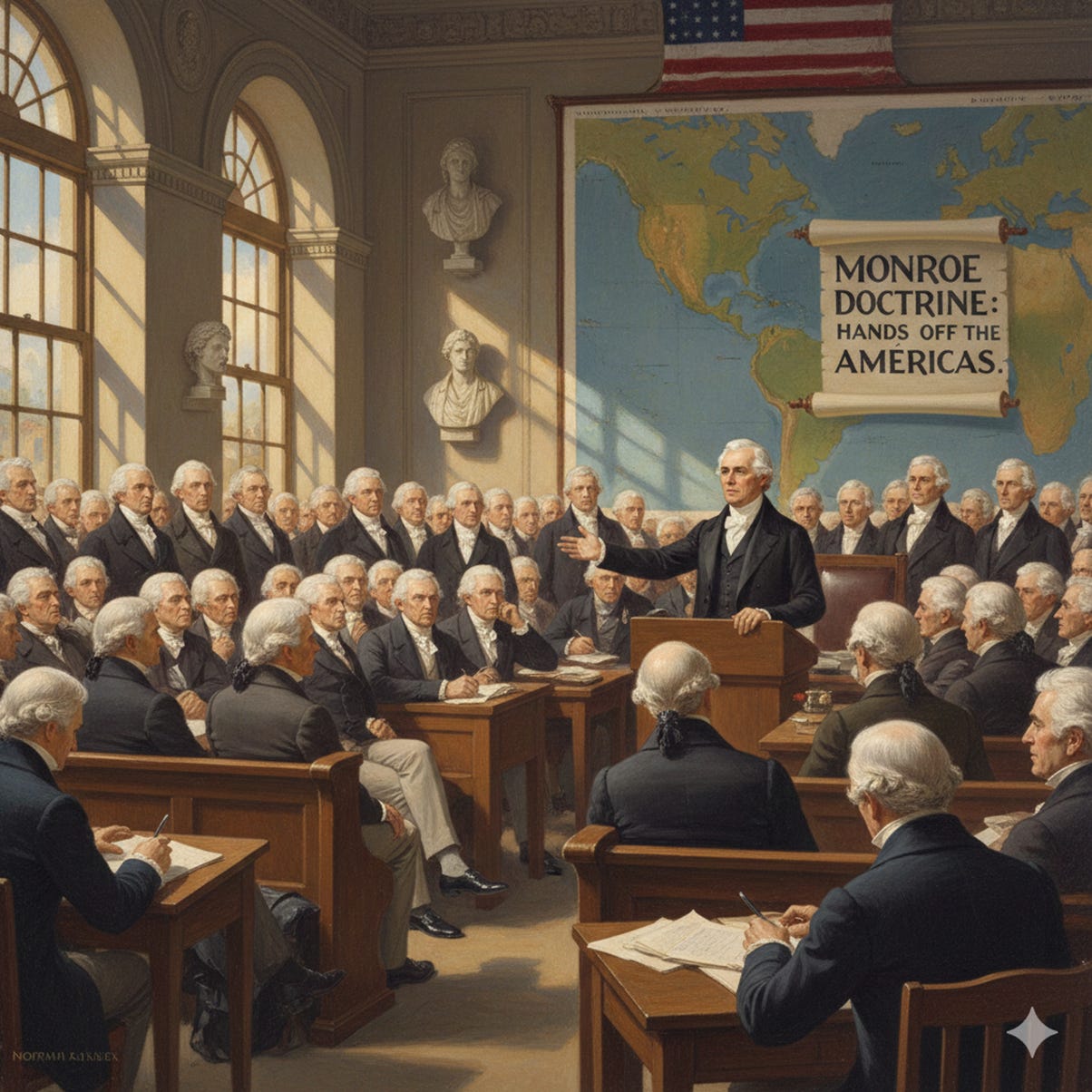
In the United States National Security Strategy of November 2025, United States interests in the Western Hemisphere are centred upon the Monroe Doctrine.
The Strategy document states:
We want to ensure that the Western Hemisphere remains reasonably stable and well-governed enough to prevent and discourage mass migration to the United States; we want a Hemisphere whose governments cooperate with us against narco-terrorists, cartels, and other transnational criminal organizations; we want a Hemisphere that remains free of hostile foreign incursion or ownership of key assets, and that supports critical supply chains; and we want to ensure our continued access to key strategic locations. In other words, we will assert and enforce a “Trump Corollary” to the Monroe Doctrine
The Trump Corollary is articulated in the following way:
After years of neglect, the United States will reassert and enforce the Monroe Doctrine to restore American preeminence in the Western Hemisphere, and to protect our homeland and our access to key geographies throughout the region. We will deny non-Hemispheric competitors the ability to position forces or other threatening capabilities, or to own or control strategically vital assets, in our Hemisphere. This “Trump Corollary” to the Monroe Doctrine is a common-sense and potent restoration of American power and priorities, consistent with American security interests.
Our goals for the Western Hemisphere can be summarized as “Enlist and Expand.” We will enlist established friends in the Hemisphere to control migration, stop drug flows, and strengthen stability and security on land and sea. We will expand by cultivating and strengthening new partners while bolstering our own nation’s appeal as the Hemisphere’s economic and security partner of choice.
The document then goes on to detail the “enlist and expand approach”.
But what is the Monroe Doctrine. Is it some obscure diplomatic policy or does it have some sort of relevance to current events. Certainly the Trump Corollary would suggest that it is very relevant and indeed needs updating for twenty-first century conditions.
What interests me and what I want to share is something of the background to what is meant by the Monroe Doctrine- what it was and how it works and what the Trump Corollary means – in the most general way- for the Western Hemisphere .
The Monroe Doctrine - 1823
The Monroe Doctrine was a pivotal American foreign policy statement delivered by President James Monroe in his annual message to Congress on December 2, 1823. At its core, it declared that the Western Hemisphere was closed to future European colonization and that any European interference in the affairs of the Americas would be viewed as a threat to U.S. security.
Origins and Context
The doctrine emerged during a period of significant geopolitical upheaval. Spain’s Latin American colonies were winning their independence in the early 1820s, and there were concerns that European powers—particularly the Holy Alliance of Russia, Prussia, Austria, and France—might attempt to help Spain reconquer these territories or establish their own colonial footholds. Russia was also expanding southward along the Pacific coast from Alaska.
Secretary of State John Quincy Adams was the principal architect behind the policy. Britain had actually proposed a joint declaration with the U.S. against European intervention, but Adams persuaded Monroe to issue a unilateral American statement instead. This reflected Adams’s vision that the United States should chart its own course rather than appear as a junior partner to Britain.
The doctrine had four main points: no further European colonization in the Americas, no European interference with newly independent American states, U.S. non-interference in European affairs, and U.S. non-interference with existing European colonies in the Americas.
Early Invocations and Evolution
Initially, the Monroe Doctrine had limited practical impact because the United States lacked the military power to enforce it. British naval supremacy actually did more to prevent European intervention in Latin America during this period. The doctrine was largely forgotten for several decades.
The policy was revived and significantly expanded in the late 19th and early 20th centuries. President Grover Cleveland invoked it forcefully in 1895 during a boundary dispute between Venezuela and British Guiana, insisting that the U.S. had a right to arbitrate the matter. The Theodore Roosevelt administration added what became known as the “Roosevelt Corollary” in 1904-1905, which dramatically reinterpreted the doctrine to justify U.S. intervention in Latin American countries to prevent European intervention over debts or disorder. Roosevelt essentially claimed the U.S. had the right to exercise “international police power” in the Western Hemisphere.
This corollary provided justification for numerous U.S. military interventions in the Caribbean and Central America in the early 20th century, including occupations of Haiti, the Dominican Republic, Nicaragua, and Cuba. These interventions generated significant resentment throughout Latin America, where the doctrine came to be seen as a tool of American imperialism rather than hemispheric protection.
20th Century Applications
During the Cold War, the Monroe Doctrine took on new significance as a tool against communist influence. The Eisenhower administration cited it when discussing the 1954 CIA-backed coup in Guatemala. The Kennedy administration invoked it during the Cuban Missile Crisis in 1962, when President Kennedy declared that Soviet nuclear weapons in Cuba were unacceptable. The Reagan administration referenced the doctrine in the 1980s to justify opposition to leftist movements in Central America, particularly in Nicaragua and El Salvador.
Modern Era
The doctrine’s relevance has been debated in recent decades. Secretary of State John Kerry declared in 2013 that “the era of the Monroe Doctrine is over,” signalling a shift toward more multilateral approaches in hemispheric relations.
However, the Trump administration appeared to revive Monroe Doctrine language when discussing Venezuela, with officials explicitly referencing it in 2019. The Biden administration has generally avoided such rhetoric, though concerns about Chinese and Russian influence in Latin America echo some of the doctrine’s original themes.
And now with the Trump Corollary it is front and centre as the driving force for US policy in the Western Hemisphere.
The “Trump Corollary” turns the Monroe Doctrine from a mainly anti‑external‑powers warning into an explicit claim of U.S. policing and management rights inside the Western Hemisphere, especially against regimes seen as hosting rivals like China, Russia, or Iran. It broadens both the triggers for intervention and the tools (military, economic, and political) the United States claims it can use to reshape governments and exclude extra‑hemispheric actors.
It asserts that the U.S. will “assert and enforce” this corollary, including redeploying forces, tightening naval control over migration and trafficking routes, and using superior military capabilities to secure access to energy and mineral resources in the region.
The Trump Corollary modifies the Monroe Doctrine from defensive to proactive. Where Monroe was framed as keeping Europe out, the Trump Corollary normalizes U.S. pre-emptive action against governments whose “internal troubles” or foreign ties are deemed a threat, including regime change and direct administration of a country, as in Venezuela.
The Trump Corollary also modifies the Doctrine from non‑involvement in great‑power politics to active hedging: instead of simply excluding European empires, the corollary is explicitly aimed at pushing back Chinese, Russian, and Iranian influence, conditioning aid and investment on rolling back their projects.
The Trump Corollary expands the Roosevelt Corollary and goes beyond Roosevelt’s language of “chronic wrongdoing” by treating alignment with U.S. strategy and openness to U.S. capital as criteria for legitimacy; governments and movements “broadly aligned” are to be rewarded, others pressured or penalized.
It also makes hierarchy explicit: analyses describe it as a doctrine in which Latin American sovereignty is overtly subordinated to U.S. security and economic preferences, formalizing a right of intervention and even “regime decapitation” in cases like Venezuela.
What the Monroe Doctrine now envisions, after the various shifts and corollaries are applied is region‑wide expanded U.S. force posture, pressure to unwind Chinese‑backed infrastructure, and efforts to “push out” foreign companies, aiming to “restore American pre-eminence in the Western Hemisphere” and ensure U.S. dominance is “never questioned again.”
The Trump Corollary is best seen as an attempt to convert a long‑standing but often implicit claim to hemispheric primacy into an explicit, hard‑power‑backed doctrine for the age of great‑power competition and Chinese capital.
Its future will likely be one of fragmentation: parts of it (blocking foreign bases, prioritizing Western Hemisphere security) may outlast the administration and be absorbed into mainstream policy, while its more extreme elements (openly governing other states, uncompensated resource control) face sustained resistance and are unlikely to solidify into a stable, widely accepted rule of inter‑American order.

Updating the Monroe doctrine involves, first, examining the difference between what it meant in 1825, to say, "Russia, the United States, China," etc., and what it means now.
Central banking has homogenised the affairs of nations, and blurred boundaries.
qu.1) So, to what degree is the naming of nations now nothing but a red herring?
qu.2) Who, now, is the real paymaster of the military forces and the secret armies of the Western world?
qu.3) Which of those secret armies is by far the biggest narco-terrorist in history?
Whose chest-thumping about international crime is nothing but cover for suppressing competition.
The answer to this quiz question is contained in the article. It starts with C and ends with A.
Don't answer qu.2 out loud. It will catapault your name up the list of surveillance targets.
Answering qu.1 in company will spoil most conversations, since most people think Trump is a powerful man, whereas, in fact, they themselves have more autonomy than he does.
Thank you for a clear and detailed explanation of this.